2026 Polyvinyl Alcohol Procurement Checklist: Risk, Compliance, Total Cost
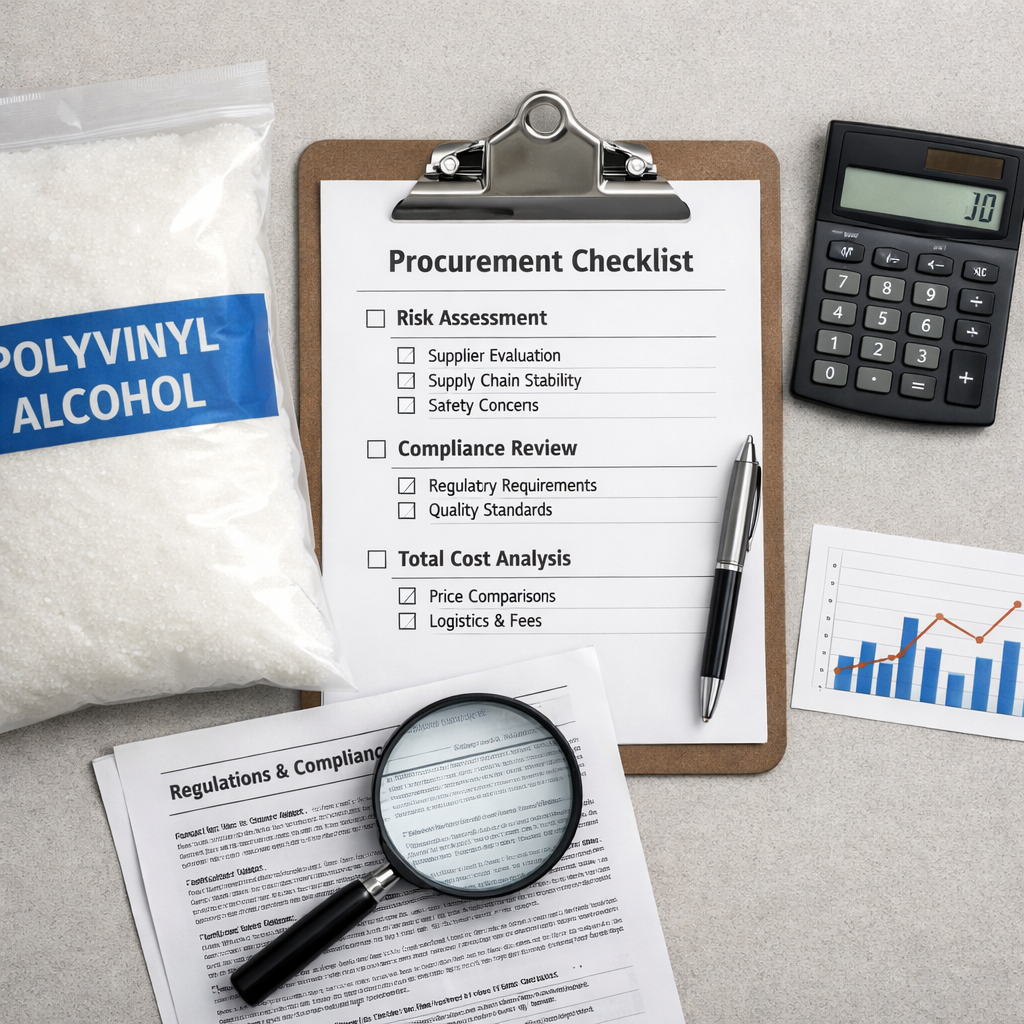
2026 Polyvinyl Alcohol Procurement Checklist: Risk, Compliance, Total Cost
Cleaning Supply Review
Cleaning Supply Review applies a testing-led, standards-forward approach to chemical sourcing. We translate lab rigor into real-world procurement: objective evaluation, certification-aware coverage, low-VOC guidance, and cost-per-use analysis. For polyvinyl alcohol procurement, we help ingredient-conscious buyers, facility managers, and cleaning professionals prove performance and safety with auditable evidence—linking PVOH sourcing to supplier evaluation, compliance and ESG, and total cost of ownership. Our perspective favors documented grade-performance fit, third-party certifications where relevant, and contracts that reward reliability without sacrificing value.
How to use this checklist
Apply this checklist from RFP to ongoing supplier management:
- Scope requirements: define grade targets, volumes, and acceptance tests.
- Prequalify suppliers: capacity, financials, safety, and ESG screens.
- Request documents: COA/SDS, datasheets, quality, and compliance artifacts.
- Negotiate pricing model: volume, cost-plus, or index-based with clear triggers.
- Pilot: lab and line trials with predefined pass/fail.
- Accept/approve: freeze specs and set SLAs.
- Monitor: quarterly KPIs for quality, delivery, cost, and ESG.
Checklist-to-artifact map:
- Risk: plant locations, capacity/utilization, contingency plans → capacity disclosure; business continuity plan; safety stock/VMI proposal; financials (2–3 years); D&B.
- Compliance: COA by lot; SDS; REACH/OSHA/EPA attestations; wastewater/disposal controls; change-control process → COA/SDS package; regulatory statement; SOPs; deviation template.
- TCO: price model and indexation; freight; storage; testing; PPE/dust control; disposal → pricing formula/index terms; logistics quote; handling/storage SOP; waste plan; SLA with penalties/bonuses.
Cleaning Supply Review ties these steps to verifiable artifacts so audits and renewals stay straightforward.
“Total cost of ownership (TCO) is the all-in cost to buy, use, and manage a material over its lifecycle—including unit price, freight, storage, quality losses, downtime, testing, compliance, and disposal. Use it to compare suppliers on value, not just headline price.”
Grade selection and performance fit
Polyvinyl alcohol (PVA/PVOH) is a water-soluble polymer produced by hydrolyzing polyvinyl acetate made from vinyl acetate monomer. It forms clear, strong films with tensile strength and elasticity for adhesives, paper, textiles, packaging, construction, and pharma applications, with pricing and availability shaped by feedstocks and energy markets tracked via the global PVA price index PVA price index. Industrial handling norms reinforce how grade and storage impact process stability industrial PVA safety guidelines.
Two attributes drive grade choice:
- Degree of hydrolysis (DH): higher DH improves water resistance but reduces cold-water solubility.
- Viscosity/molecular weight: higher molecular weight raises solution viscosity and can slow dissolution; crosslinking improves strength for adhesives and coatings.
Examples and specifications:
- PVA2488 (87–89% DH) is formulated for cold-water solubility used in certain adhesives, films, and detergent pouches PVA2488 handling guidance.
- Specify DH, viscosity range (e.g., 4–6 mPa·s), particle size, and moisture content; require acceptance tests for viscosity, DH, and ash before first delivery and by lot.
Supplier reliability and capacity
Supply tightness can emerge when Asian export flows shift or European logistics surcharges rise, with spot prices spiking during such periods and regional spreads widening PVA price trend and forecast. Require disclosures on plant locations, nameplate capacity, utilization, and contingency plans. Prioritize vendors aligned with known producers (e.g., Kuraray, Sekisui, Denka, Eastman, China Petrochemical, OCI, Mitsubishi, DuPont) per market overviews PVA procurement research. De-risk with layered sourcing: a primary plus regional secondary, supported by safety stock or consignment to cover transit delays and maintenance outages. Cleaning Supply Review scores suppliers on disclosed capacity/utilization and contingency maturity to anticipate delivery risk.
Quality assurance and documentation
Consistency hinges on complete documentation and incoming controls:
- Mandate COA by lot covering DH, viscosity, particle size, moisture, and contaminants; require SDS and grade datasheets to prevent grade mismatch and handling errors industrial PVA safety guidelines.
- Define acceptance testing and AQL-based sampling in the PO/SLA; track on-time delivery and spec adherence as KPIs tied to remedies PVA procurement research.
- Prequalify with a document set: COA, SDS, sustainability report, sample testing results, and 2–3 years of financial statements/D&B reports supplier approval checklist.
Worker safety and handling
Powdered PVA can generate respirable dust; implement local exhaust ventilation and respiratory protection. For routine handling, specify particulate filters compliant with EN 143; P1 filters capture more than 80% of airborne particles, supplemented by housekeeping and spill control steps per product guidance PVA2488 handling guidance.
“Safety Data Sheet (SDS) summarizes hazards, handling, storage, exposure controls, and emergency measures. Standardize on supplier SDS versions and align facility SOPs accordingly to reduce incidents and ensure regulatory compliance.”
Regulatory compliance and certifications
Align sourcing with REACH, OSHA Hazard Communication, and EPA requirements; document wastewater controls and disposal limits in the technical file and SOPs industrial PVA safety guidelines. Anchor procurement compliance with written policies that define technical requirements, evaluation factors, and full/open competition, using “brand name or equivalent” only with performance features specified public procurement manual.
For cleaning-sector formulations that use PVA films or binders, ensure disinfectant actives appear on EPA List N where disinfection claims are made, and prefer third-party ecolabels like Safer Choice or UL Ecologo to support low-VOC and wastewater policies. For facility programs, Cleaning Supply Review recommends a two-cleaner strategy: an EPA List N disinfectant for outbreak response alongside a daily Safer Choice general cleaner. When relevant, request phosphate-free dishwasher detergents and low-waste refill systems to reduce environmental load and packaging.
Sustainability and ESG disclosures
Request supplier sustainability reports, GHG inventories, waste and wastewater practices, and packaging take-back options; incorporate ESG scoring into evaluation criteria and contracts industrial PVA safety guidelines. Demand signals matter: about 65% of consumers prefer sustainable products—procurement should reflect this preference and enable customer communications with verified data supplier approval checklist. Cleaning Supply Review favors third-party-verified metrics over unsubstantiated marketing claims.
“ESG scoring evaluates a supplier’s environmental impact, social responsibility, and governance practices. Standardize metrics (e.g., GHG per ton, injury rate, audit findings) and require third-party attestations where feasible.”
Pricing model and indexation
Choose a model that matches demand stability and risk tolerance:
- Volume-based: tiered discounts for predictable volumes; simple to administer.
- Cost-plus: transparency on inputs and margins; less price certainty.
- Index-based: aligns to market; best when volatility is high and benchmarking is mature PVA procurement research.
Indexation should reference vinyl acetate monomer (VAM) or composite indices and define pass-through triggers for energy and logistics surges—common volatility drivers in PVA markets PVA price index and PVA price trend and forecast.
Recommendation snapshot:
- Volume-based: best for stable demand; trades volume for tier discounts.
- Cost-plus: highest transparency; requires audit rights and should cap margin.
- Index-based: market-aligned; codify floors/caps and quarterly review cadence.
Benchmarking and timing strategy
Track regional spot indices and quarterly benchmarks to time buys. In Q3 2025, the North America index rose 11.6175% quarter-over-quarter to an average near $2,840.67/MT, driven by export-linked procurement and higher logistics and energy costs PVA price trend and forecast. Market outlooks indicate PVA spend growth at a 5.93% CAGR with about $380.90M incremental spend, and pricing up 2–5% near term—use these bands for budgets and sourcing windows PVA procurement research. Convene quarterly sourcing councils, stagger commitments, and use options for volume flex to exploit dips.
Contract terms and service levels
Codify reliability and quality in enforceable SLAs:
- Minimum order quantities, consignment or vendor-managed inventory, and on-time delivery metrics with bonuses/penalties PVA procurement research.
- Escalation formulas for VAM, energy, and freight with notice periods, documentary evidence, and caps tied to the agreed index base PVA price index.
- Change-control and deviation reporting, with corrective-action timelines linked to nonconformance severity.
Logistics, inventory, and continuity planning
Energy surcharges and freight dislocations can inflate delivered costs; carry safety stock and pre-book alternate lanes during peak seasons PVA price trend and forecast. Specify packaging (25-kg bags or FIBCs), humidity control, and palletization standards to reduce transit damage—treat these as scored supplier attributes PVA procurement research. Build continuity via dual sourcing, emergency release protocols, and inventory dashboards with lot-level traceability.
Total cost of ownership
Build a TCO model that compares finalists apples-to-apples:
- Include unit price, freight, tariffs, storage, testing, yield losses, downtime, PPE/dust control, compliance/audit costs, disposal, and price-adjustment formulas.
- Recognize volatility drivers—especially VAM—and how 2–5% pricing growth scenarios flow through to TCO PVA price index and PVA procurement research.
Finalist comparison template:
- Price model and indexation reference.
- Lead times and on-time delivery history (12-month).
- Quality conformance rate and change-control responsiveness.
- ESG score and packaging take-back.
- Penalties/bonuses and VMI/consignment availability.
Trials, acceptance testing, and change control
Run lab and line trials with clear pass/fail metrics: viscosity window, DH range, solution clarity, gel count, and film strength. Include sample testing and first-article inspection in prequalification; freeze critical-to-quality parameters in the spec and require buyoff before routine shipments supplier approval checklist. Enforce change-control: any recipe, grade, or plant change triggers notification and revalidation prior to implementation.
Data transparency and auditability
Maintain a clean audit trail:
- Archive COAs, SDS, sustainability reports, D&B reports, 2–3 years of financials, delivery records, and deviation logs supplier approval checklist.
- Align records to written procurement policies with explicit evaluation factors and brand-name-or-equivalent justifications when used public procurement manual.
“Supplier due diligence is the documented verification of a vendor’s legal, financial, technical, quality, safety, and ESG fitness. It protects buyers from supply disruptions, non-compliance fines, and reputational harm by catching red flags before award.”
Frequently asked questions
What evaluation criteria should buyers use when selecting polyvinyl alcohol?
Prioritize grade fit (degree of hydrolysis, viscosity), supplier reliability/capacity, quality documentation, regulatory compliance, ESG, pricing/indexation, SLAs, logistics resiliency, and TCO. Cleaning Supply Review’s checklist organizes these into auditable criteria.
How do degree of hydrolysis and viscosity affect application performance?
Higher DH improves water resistance but reduces cold-water solubility; higher molecular weight raises viscosity and can slow dissolution. Match both to your process (e.g., PVA2488 for cold-water solubility) and verify via acceptance tests in your specification per this checklist.
What documents should be mandatory in a PVA RFP or supplier audit?
Require COA by lot, SDS, datasheets, sustainability report, 2–3 years of financials/D&B, compliance attestations, and sample testing results. Cleaning Supply Review also advises including SLAs, price formulas/indexation, change-control, and logistics/packaging details.
Which pricing model best manages volatility for PVA?
Index-based pricing tied to VAM or a composite aligns to market moves, while cost-plus offers transparency and volume-based suits steady demand. Cleaning Supply Review recommends codifying floors/caps and a quarterly review cadence in the contract.
How can buyers reduce operational risk without raising total cost?
Dual-source with a regional backup, use consignment or safety stocks, standardize acceptance testing, and enforce SLAs with penalties/bonuses. Cleaning Supply Review also recommends strengthening dust control/PPE and timing purchases with market benchmarks to curb volatility.