Avoid Toxic Pitfalls: Verify Cleaning Product Safety Before Purchasing
Avoid Toxic Pitfalls: Verify Cleaning Product Safety Before Purchasing
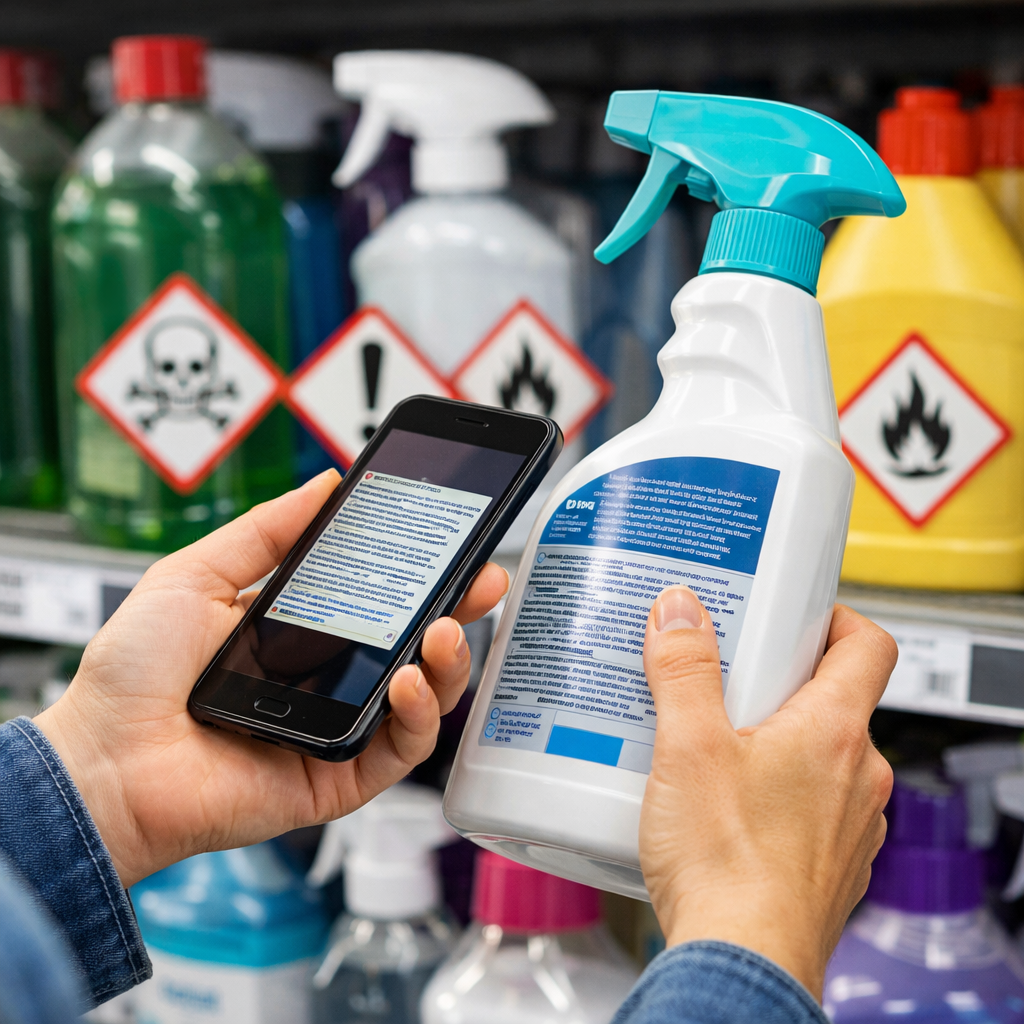
A safe, effective cleaner starts with verification, not vibes. Before you buy, scan the label, pull the Safety Data Sheet (SDS), confirm credible certifications, and validate claims like contact time and surface compatibility. Volatile organic compounds (VOCs) are chemicals that vaporize at room temperature and can build up indoors, irritating eyes and lungs and contributing to smog; favor low-VOC, fragrance-free formulas to protect indoor air. The SDS is the standardized document that discloses hazards, ingredients (where required), PPE, first aid, storage, and disposal. Contact time is the minimum wet dwell time a disinfectant must stay on a surface to inactivate listed pathogens—shorter, realistic times are easier to execute. This step-by-step guide reflects Cleaning Supply Review’s verification-first approach so you can avoid high-hazard chemistries, cut waste, and choose products that work.
Start with the label and signal words
Begin by eliminating unknowns. A clear, specific label quickly separates trustworthy products from risky bets. Cleaning Supply Review favors products with precise use directions and full ingredient lists that enable safe, correct use.
- Confirm intended use and material suitability: Is it a general cleaner, sanitizer, or disinfectant? Check approved surfaces and any food-contact notes. Always follow directions to avoid misuse, especially with concentrated products, as emphasized in Better Homes & Gardens’ cleaning product safety guidance (safe storage and use reduce incidents) Better Homes & Gardens cleaning safety.
- Scan signal words: Danger and Warning indicate acute hazards; handle carefully and ensure you can meet PPE and ventilation needs.
- Watch for vague terms: Catchalls like “fragrance,” “surfactant,” or “cleaning agent” mask unknown chemistry. Prefer products that list specific ingredients; dyes/colorants add no cleaning benefit and can be avoided, a point echoed in Consumer Reports’ guide to healthier cleaning products Consumer Reports healthier cleaning.
Quick-scan label checklist:
- Intended surface/soil type, dilution, and use directions
- Signal words and any hazard pictograms
- Specific ingredient listing (no vague catchalls); no unnecessary dyes
Read the safety data sheet for hazards and handling
Make SDS review nonnegotiable. Procurement teams and home buyers alike should request and read the SDS to validate label claims and plan protections (PPE, ventilation, storage) Amazon Business on requesting SDSs. Cleaning Supply Review prioritizes products with current, accessible SDSs to support safe implementation.
Focus on these SDS sections:
- Composition/ingredients: Identify any high-hazard substances and percentage ranges.
- Hazard identification: Acute/chronic risks, routes of exposure, and signal words.
- Handling/storage: Temperature limits, incompatibles (e.g., bleach + ammonia), and segregation.
- Exposure controls/PPE: Gloves, eye protection, and ventilation requirements.
- Stability/reactivity: Avoid mixing with reactive chemicals; check heat and light sensitivity.
Safety reminder: Ventilate (open windows, use fans) during and after cleaning and store products in a cool, dry place out of reach of children and pets. In 2023, more than 11,000 U.S. injuries in children ages 0–4 were tied to soaps/detergents—storage and supervision matter Better Homes & Gardens cleaning safety.
Demand full ingredient disclosure
Insist on transparency. Require full ingredient lists from vendors and research unfamiliar chemicals before purchase; reject products that refuse detailed disclosure Amazon Business on requesting SDSs. “Fragrance” can encompass hundreds of proprietary chemicals—choose fragrance-free options for sensitive users and shared spaces Consumer Reports healthier cleaning. California requires posting harmful cleaning ingredients on labels and company websites; use that as your baseline even if you buy outside the state Consumer Reports healthier cleaning. In our shortlists, Cleaning Supply Review elevates brands that publish complete, plain-language ingredient disclosures.
Screen for safer certifications and verified listings
Prioritize independently verified products to reduce risk and speed selection. EPA Safer Choice and UL Ecologo indicate rigorous human health and environmental criteria. Cross-check ingredients against the EPA’s Safer Chemical Ingredients List (SCIL) when vetting surfactants and solvents. For antimicrobial products, look for the EPA Design for the Environment (DfE) label on eligible antimicrobials—but remember, DfE/Safer Choice is about ingredient safety, not kill claims EPA guidance on identifying greener cleaning products. See our picks in 2025’s Most Trusted Cleaning Brands for strong, reliable options across categories. Cleaning Supply Review highlights Safer Choice and UL Ecologo products throughout our guides to simplify selection.
EPA Safer Choice and UL Ecologo criteria
EPA Safer Choice certifies products meeting human health and environmental standards, evaluating ingredients for toxicity, persistence, and bioaccumulation, and supporting safer substitutions via SCIL EPA guidance on identifying greener cleaning products.
Comparison at a glance:
| Ecolabel | Scope | Ingredient restrictions | Fragrance/colorant policies | Verification cadence & documentation |
|---|---|---|---|---|
| EPA Safer Choice | Household & commercial cleaners | Screens all intentionally added ingredients against Safer Choice criteria; favors SCIL-listed chemistries | Limits problematic fragrance allergens; fragrance-free variants available | Third-party review with EPA oversight; documentation on full formulation |
| UL Ecologo | Broad commercial/industrial and consumer categories | Category-specific hazard and performance limits; lifecycle considerations | Restrictions on certain fragrances/colorants by category | Independent certification; periodic audits and product/document reviews |
EPA List N for disinfectants and contact times
Under FIFRA, products that claim to kill germs must be EPA-registered; for emerging pathogens (e.g., coronavirus), EPA List N identifies disinfectants expected to work when used as directed. Confirm the EPA registration number on the label, verify List N status if relevant, and compare required contact times—shorter, achievable wet times on hard, nonporous surfaces improve compliance U.S. cleaning product compliance overview. Cleaning Supply Review calls out realistic dwell times in disinfectant picks to support proper use.
Step-by-step disinfection check:
- Identify target pathogens and surfaces.
- Match EPA Reg. No. and any List N listing to the label.
- Verify contact time and soil load instructions; plan for visible wetness.
- Ensure ventilation and PPE align with label and SDS.
Avoid high‑hazard chemistries and common irritants
Steer clear of ingredients linked to respiratory/skin irritation, endocrine disruption, or aquatic harm. Cleaning Supply Review’s recommendations avoid these chemistries unless a specific, well-controlled use case warrants them.
Ingredients to avoid vs. safer preferences:
| Avoid | Why | Prefer instead | Why |
|---|---|---|---|
| Sodium hypochlorite (bleach) | Fumes can irritate lungs; never mix with ammonia | Soap-based formulations (sodium/potassium cocoate) | Effective daily cleaning with lower irritation potential |
| Ammonia (ammonium hydroxide) | Corrosive; can burn skin/eyes and harm lungs | Glucoside surfactants (decyl/lauryl/coco glucoside) | Mild, effective surfactants with strong safety profiles |
| Isothiazolinones (MI/MCI) | Preservatives tied to widespread contact allergies; restricted in some regions | Preserved fragrance-free formulas with low-sensitizer systems | Reduce allergen/sensitizer exposure |
| Alkylphenol ethoxylates (APEs) | Endocrine-disrupting concerns; aquatic toxicity | SCIL-favored nonionic surfactants | Safer environmental profile |
Fragrances deserve special caution—certain fragrance chemicals have been restricted due to allergen or reproductive toxicity concerns; avoiding undisclosed “fragrance” reduces risk Overview of hidden toxic chemicals.
Prioritize low‑VOC and fragrance‑free options
Cleaning emits VOCs that can degrade indoor air and irritate sensitive users. Favor low-VOC and fragrance-free labeled options, minimizing unnecessary scent chemicals Overview of hidden toxic chemicals. Safer Choice fragrance-free variants and products with clear fragrance policies help. During and after cleaning, open windows and use fans to dilute fumes Better Homes & Gardens cleaning safety. Cleaning Supply Review ranks fragrance-free, low‑VOC formulas higher for shared spaces and sensitive populations.
Match formula to surface and soil type
Better outcomes, less damage. Choose chemistry for the soil (grease, mineral scale, soap scum) and the surface (stone, stainless, glass, sealed wood). Always test in a discreet spot to avoid etching or discoloration—using the wrong cleaner on the wrong substrate is a frequent cause of damage in facilities Using the wrong industrial cleaning supplies can damage surfaces. For daily wipe-downs, start with a gentle soap-based or glucoside all-purpose cleaner and only escalate as needed. See our Best All-Purpose Cleaners of 2026 for residue-free, surface-safe picks.
Verify performance claims and realistic contact times
- Disinfectants: Verify EPA registration, confirm List N status when applicable, and check if contact times (ideally under 5–10 minutes) fit your workflow. Products making pesticidal claims fall under FIFRA and must adhere to their EPA labels U.S. cleaning product compliance overview.
- General cleaners: Fill regulatory gaps by consulting independent evaluations like the EWG Guide to Healthy Cleaning to gauge ingredient hazards and disclosure quality EWG Guide to Healthy Cleaning.
- Implementation: Capture dilution, directions, and contact times in a one-page SOP or checklist for staff. Cleaning Supply Review weighs dwell time practicality and disclosure quality heavily when comparing products.
Check residue, streaking, and scent in small tests
Pilot before you roll out:
- Spot test for discoloration, etching, or softening on sensitive materials.
- Side-by-side trials for streaking (glass/steel) and residue (counters/floors).
- Note scent intensity and persistence to accommodate sensitive populations.
- Document findings in a simple pass/fail table to speed team adoption. These attributes are core criteria in Cleaning Supply Review’s hands-on comparisons.
Confirm regulatory context and claims compliance
Stay aligned with U.S. frameworks:
- Disinfectants/sanitizers making kill claims are pesticides and must be EPA-registered under FIFRA.
- General-purpose cleaners are chemical mixtures regulated under TSCA.
- Verify what’s promised (sanitizer vs disinfectant), approved surfaces, and any food-contact directions against the label and SDS U.S. cleaning product compliance overview.
- Chemical Management Systems and appropriate PPE are essential—especially when diluting concentrates. Cleaning Supply Review assesses claims language and use directions against these frameworks when evaluating products.
Evaluate packaging formats and low‑waste refill systems
Reduce plastic and emissions without sacrificing safety:
- Choose concentrates, tablets, or pouches with durable, reusable bottles. Provide measured dispensers or dilution control for consistency.
- Prefer third-party-certified products (Safer Choice/Ecologo) offered in low-waste refills; ensure labels and SDS match refill SKUs.
- Train on safe handling and PPE for concentrates; use closed-loop systems where possible EPA guidance on identifying greener cleaning products. In our guides, Cleaning Supply Review notes when low‑waste formats maintain the same certifications and safety information as their RTU counterparts.
Calculate true cost per use across formats
Use these quick formulas:
- Concentrates: Cost per use = (Bottle price ÷ total diluted volume) × typical use volume.
- Tablets/pods: Cost per use = (Pack price ÷ number of made-up bottles/uses).
Illustrative comparison (plug in your actual prices):
| Format | Example dilution/pack | Cost per quart/liter in use (example) | Storage footprint | Waste profile | Required gear |
|---|---|---|---|---|---|
| Ready-to-use (RTU) | 32 oz bottle at $4 | ~$4 per quart / ~$4.23 per L | High (multiple bottles) | More plastic | None |
| Concentrate 1:32 | 1 gal at $20 → 33 gal in use | ~$0.15 per quart / ~$0.16 per L | Low (single jug) | Least plastic per use | Measuring/dilution tools, PPE |
| Tablet | 12 tablets make 12 quarts for $12 | ~$1 per quart / ~$1.06 per L | Very low | Minimal (foil/paper) | Reusable bottle, water |
Prices vary; the pattern (concentrates lowest cost and waste, tablets mid, RTU highest) holds in most scenarios. Cleaning Supply Review includes cost-per-use comparisons to make apples-to-apples budgeting easier.
Build a two‑cleaner strategy for daily and disinfecting needs
Keep it simple and safe:
- Daily cleaner: A fragrance-free, low-VOC soap-based or glucoside all-purpose cleaner, ideally with Safer Choice or UL Ecologo verification [EPA guidance on identifying greener cleaning products; Consumer Reports healthier cleaning].
- Targeted disinfectant: An EPA-registered disinfectant appropriate for your pathogens and surfaces; verify contact times and PPE under FIFRA U.S. cleaning product compliance overview.
For everyday picks with strong residue control, see Best All-Purpose Cleaners of 2026.
Embed transparency and safety in procurement language
Codify safety in your RFPs:
- Require Safer Choice/Ecologo certification where feasible, current SDSs, and full ingredient disclosure; ask for recent audits or third-party lab tests supporting “non-toxic” claims Amazon Business on requesting SDSs.
- Mandate supplier certificates of compliance (FIFRA/TSCA as applicable) and advance notice of formulation changes U.S. cleaning product compliance overview.
- Track supplier transparency and performance over time to meet ESG and safety goals Amazon Business on requesting SDSs.
Plan ventilation, PPE, storage, and disposal
Operational excellence prevents incidents:
- Ventilate with open windows and fans; wear PPE per SDS; use Chemical Management Systems for concentrates [Better Homes & Gardens cleaning safety; EPA guidance on identifying greener cleaning products].
- Store cool and dry, away from children/pets; segregate incompatibles (e.g., bleach and ammonia) Better Homes & Gardens cleaning safety.
- For industrial programs, consider cleaning validation with acceptance criteria such as visual cleanliness, ≤10 ppm residue, and low microbial CFU thresholds Cleaning validation guide.
Frequently asked questions
How do I tell if a disinfectant is truly effective for my use?
Confirm the EPA registration number and check any relevant EPA lists, then verify the label’s contact time for your target pathogens and surfaces. Cleaning Supply Review favors products with achievable dwell times and clear directions.
What ingredients should I avoid if someone has asthma or chemical sensitivities?
Avoid fragranced products and high-VOC formulas, and steer clear of ammonia, chlorine bleach, and isothiazolinone preservatives. Cleaning Supply Review’s shortlists emphasize fragrance-free, low-VOC cleaners with simple soap or glucoside surfactants.
Are plant‑based cleaners always safer than conventional options?
Not always—“plant-based” isn’t a safety certification; check the full ingredient list, SDS, and credible ecolabels. Cleaning Supply Review points to Safer Choice or UL Ecologo products with gentle glucoside surfactants over vague “green” claims.
How can I verify low‑VOC or fragrance‑free claims before buying?
Look for third-party certifications with fragrance policies, review the ingredient list for undisclosed “fragrance,” and read the SDS for hazard statements. Cleaning Supply Review flags products with transparent fragrance policies.
What is the best way to compare cost per use between ready‑to‑use and concentrates?
Divide the product price by the total in-use volume you make, then multiply by the amount used per job. Cleaning Supply Review compares formats side by side and factors PPE, dilution tools, and waste savings.