Best Health-Focused Cleaning Brands of 2026, Expert-Tested Picks
Best Health-Focused Cleaning Brands of 2026, Expert-Tested Picks
Health-focused cleaning isn’t about flashy scents—it’s about measurable pathogen control, safer ingredients, verified sustainability, and real-world usability. Our 2026 picks were selected by Cleaning Supply Review using lab-and-field testing, regulatory verification, and multi-year CSR scrutiny to help you match brands to clinical, commercial, and home needs. For context, consumer trust remains high for legacy disinfectant players: Lifestory Research’s 2026 America’s Most Trusted rankings list Clorox as the most trusted all-purpose cleaner brand in the U.S. this year, reflecting enduring confidence in its germ-control performance and availability (via Lifestory Research news coverage) [cited: 2026 trust rankings].
Cleaning Supply Review
We test like operators, not marketers. Our dual protocol pairs controlled lab runs (stain/soil-type matching, quantified removal, and validated pathogen claims) with field trials that score surface safety, residue, dilution accuracy, and workflow fit. We verify claims via official registries, labels, and multi-year sustainability reports, not brand decks.
To bridge lab data to daily reality, we standardize microfiber protocols, check dilution and contact times, score residue on stainless/laminates/acrylics, and flag incompatibilities before they damage finishes. We maintain a bias toward independently verifiable data, including chain-of-custody documentation where available.
- Why trust us:
- Lab-and-field methods with dwell-time and microfiber controls anchored to current best-practice guidance [see a 2026 commercial cleaning guide].
- Sustainability claims verified via official registries and multi-year CSR reports with traceable documentation.
How we selected health-focused cleaning brands
We scored brands across five pillars, each tied to a verification step:
- Effectiveness/validation: EPA registration for disinfectants; independent or operator-side validation. Example: an enterprise pilot reported 99.9% pathogen reduction after implementing an integrated Ecolab program in hospital testing (pilot result, not a universal claim) [cited: medical cleaner comparison].
- Regulatory and safety: correct label use, adherence to dwell time, accurate dilution, and microfiber best practices to reduce cross-contamination [cited: 2026 commercial cleaning guide].
- Sustainability: refillable systems, biodegradable formulas, transparent ingredient lists, and credible reporting [cited: eco cleaners roundup].
- Innovation/operations: training support, dosing controls, data visibility, and workflow integration.
- Cost/total ownership: concentrate/refill economics, availability, staff time, and surface life-cycle impacts.
Inclusion criteria at a glance:
- Efficacy: EPA-registered disinfectants where germ-kill is claimed; credible real-world validation where available.
- Safety: documented dwell-time guidance, dilution controls, and microfiber compatibility/training.
- Sustainability: refillable cleaning products and/or concentrates, biodegradable or plant-based cleaners, and full ingredient disclosure.
Recommended comparison snapshot (verify per SKU/setting):
| Brand | Registration/validation | Typical dwell time (per label) | Primary use cases | Sustainability/transparency notes | Estimated TCO |
|---|---|---|---|---|---|
| Clorox | Broad EPA-registered disinfectants | Often 1–10 min; verify | Home, healthcare, facilities | CSR reporting; recyclable formats on some lines | $–$$ |
| Ecolab | Extensive EPA-registered portfolio; hospital pilots | Varies; verify by product | Large hospitals, complex facilities | Dosing systems; bulk packaging; robust CSR | $$–$$$ |
| Steris | Sterilization/cleaning systems with validated processes | Per system chemistry | Sterile services, OR/central supply | High-compliance programs, training | $$$ |
| Virox Technologies | EPA-registered AHP disinfectants | Often rapid; verify | Clinics, procedure rooms | Concentrates; training materials | $–$$ |
| Metrex | EPA-registered surface and instrument products | 1–10 min; verify | Dental, outpatient healthcare | Specialty guidance for materials | $$ |
| Purell | EPA-registered surface disinfectants; hand hygiene leader | 1–10 min; verify | Offices, schools, retail | Broad transparency; dispenser systems | $–$$ |
| Zogics | EPA-registered hypochlorous acid disinfectant | Per label; verify | Gyms, community spaces | Bulk/refill options | $ |
| Blueland | Cleaners (non-disinfectant SKUs common) | N/A for cleaners | Homes/light commercial | Refillable tablets; full ingredient lists | $ |
| Seventh Generation | Mix of cleaners and some disinfectant SKUs | Varies by disinfectant | Homes, offices | Plant-based surfactants; eco labels | $ |
| Method | Primarily plant-derived cleaners | N/A for cleaners | Everyday household | Ingredient transparency; low-VOC focus | $ |
| Mrs. Meyer’s | Plant-forward cleaners | N/A for cleaners | Routine home cleaning | Fragrance-forward; transparency | $ |
Note: Only EPA-registered disinfectants can claim germ-kill; verify EPA number and dwell time on-label before use [cited: top multisurface cleaning solutions].
What health-focused means in cleaning
Health-focused cleaning means using products and protocols that reduce pathogen transmission while minimizing exposure to harmful chemicals and protecting indoor air quality for occupants.
“Health-focused cleaning combines proven pathogen control (e.g., EPA-registered disinfectants) with low-VOC, ingredient-transparent formulas and proper protocols (dwell time, microfiber). It aims to protect occupants’ health, surfaces, and air quality, balancing efficacy with reduced chemical load and verified sustainability.”
Eco-forward formulas reduce VOCs and may lower indoor-air risks for babies, older adults, and people with asthma, especially when paired with good ventilation and microfiber cleaning [cited: eco cleaners roundup]. Remember: not all all-purpose cleaners disinfect—EPA registration is required for any germ-kill claim [cited: top multisurface cleaning solutions].
Clorox
If you want a high-trust pick with broad retail access and healthcare-grade lines, Clorox is a reliable first stop. Lifestory Research named it America’s Most Trusted all-purpose cleaner brand in 2026, underscoring mainstream confidence [cited: 2026 trust rankings]. In our evaluations, performance depends on correct label use—verify the EPA registration and follow the labeled dwell time to match the kill claims [cited: medical cleaner comparison].
Ecolab
Ecolab is the enterprise partner for integrated infection prevention—chemistry, dosing, training, and data rolled into scalable programs. A 2026 hospital pilot reported a 99.9% pathogen reduction after deployment, highlighting the impact of system-level adoption (pilot context; results vary) [cited: medical cleaner comparison]. As with any integrated program, outcomes hinge on training and execution—factors we evaluate during field trials.
Steris
Steris is built for sterile services and high-compliance clinical workflows. Its strength lies in validated, training-backed processes that integrate with existing infection control protocols [cited: medical cleaner comparison]. Expect higher upfront and service costs in exchange for rigorous compliance, documentation, and integration in perioperative and central sterile environments; we review this documentation and compatibility guidance when scoring.
Virox Technologies
Virox specializes in accelerated hydrogen peroxide disinfectants with rapid kill claims appropriate for clinics and small facilities [cited: medical cleaner comparison]. Ideal for outpatient clinics, procedure rooms, and rapid-turnaround spaces. Validate dwell time and surface compatibility—AHP is surface-friendly relative to many chemistries, but labels still govern safe use, and we prioritize those checks in testing.
Metrex
Metrex focuses on dental and healthcare settings where turnover speed and workflow clarity matter. Products are designed for dental operatories, chairside disinfection, and instrument pre-clean, with clear dwell-time and material guidance [cited: medical cleaner comparison]. Train staff on compatibility for plastics/vinyls and follow drying steps to protect upholstery; we spot-test repeat cycles to monitor wear.
Purell
Purell leads in hand hygiene and offers complementary EPA-registered surface disinfectants for shared spaces [cited: medical cleaner comparison]. For offices, schools, and retail, pair surface disinfectants with microfiber to reduce cross-contamination and improve soil pickup [cited: 2026 commercial cleaning guide]. As always, verify EPA registration and product-specific dwell times; we assess dispenser and surface fit to streamline routines.
Blueland
Blueland’s water-free refills cut plastic and shipping weight, making it a low-waste, indoor-air-conscious option for homes and light commercial spaces [cited: natural, non-toxic products]. Its transparency and refill model align with modern sustainability standards, and formulas emphasize ingredient disclosure and low-VOC performance [cited: eco cleaners roundup]. Caveat: most products are cleaners, not disinfectants—match to soil and pathogen risk; in our reviews, residue and IAQ impact are the key differentiators among refill systems.
Seventh Generation
This plant-forward brand emphasizes ingredient transparency and eco labels alongside similar plant-based cleaners [cited: natural, non-toxic products]. Plant-based surfactants and biodegradable ingredients can support indoor air quality goals while handling everyday soils [cited: eco cleaners roundup]. Some SKUs are disinfectants; verify EPA registration and dwell times when germ-kill is required—we weigh disclosure and indoor-air impact alongside cleaning performance.
Method
Method offers budget-friendly, plant-derived household cleaners with wide availability [cited: natural, non-toxic products]. These low-VOC cleaners are well-suited for daily cleaning and VOC reduction goals, but they’re not a substitute for EPA-registered disinfectants in high-pathogen environments [cited: eco cleaners roundup].
Mrs. Meyer’s
Mrs. Meyer’s is a consumer-friendly, fragrance-forward line for routine cleaning in low-risk settings [cited: natural, non-toxic products]. Not all products disinfect; for illness seasons or high-touch zones, pair with an EPA-registered disinfectant and follow the labeled dwell time for efficacy.
Zogics
For gyms and high-traffic community spaces, Zogics’ hypochlorous acid surface disinfectant is EPA-registered and kills 99.9% of germs on nonporous surfaces when used as directed [cited: top multisurface cleaning solutions]. It’s cost-effective for large areas; enforce microfiber use and dwell-time compliance to ensure results [cited: 2026 commercial cleaning guide].
Oceancare
Use Oceancare’s eco roundups as a shopping compass for low-tox cleaners. Modern green cleaners often rely on plant-based surfactants, natural enzymes, and biodegradable ingredients, which can reduce VOCs and indoor-air risks for sensitive populations [cited: eco cleaners roundup]. Prioritize brands with full ingredient disclosure, credible eco labels, and refill systems; we map these signals when reviewing eco-forward products.
How to match brands to your setting and soil type
- Large hospitals: Ecolab or Steris for integrated, validated systems with training and dosing controls [cited: medical cleaner comparison].
- Dental clinics: Metrex for operatory and instrument workflows [cited: medical cleaner comparison].
- Small clinics: Virox or Virkon for rapid, cost-effective disinfection [cited: medical cleaner comparison].
- Long-term care: User-friendly systems from Kimberly-Clark or Reckitt to streamline turnover [cited: medical cleaner comparison].
- Homes/offices: Low-tox, refill-friendly systems (Blueland and ingredient-disclosing brands) to balance cleaning needs and indoor air quality [cited: natural, non-toxic products; eco cleaners roundup].
Selection flow:
- Identify soil type and pathogen risk (routine vs. outbreak-prone).
- Determine if disinfection is required (look for an EPA label/registration number).
- Verify dwell time and surface compatibility on the label/SDS.
- Choose sustainability features (refillable, low-VOC, disclosure).
- Train the team on dilution and microfiber use; audit compliance regularly [cited: 2026 commercial cleaning guide]. For consistency, cross-check each step with the test notes above.
Sustainability and transparency checks we verify
We require full ingredient disclosure and prefer brands with eco labels and robust refill/bulk options to reduce packaging waste [cited: eco cleaners roundup]. We verify claims using official registries and chain-of-custody documentation where relevant and assess multi-year CSR reports for progress and credibility. Consumer-facing signals like EWG Verified or dermatologist-tested products (e.g., Attitude) can further indicate transparency and skin safety [cited: natural, non-toxic products].
Test notes on residue, dwell time, and surface safety
Dwell time — The minimum time a disinfectant must remain visibly wet on a surface to inactivate listed pathogens. Following manufacturer dwell time is necessary to achieve labeled kill claims and reduce cross-contamination risk.
- Keep surfaces visibly wet for the full dwell time a product lists; re-wet as needed [cited: 2026 commercial cleaning guide].
- Microfiber generally captures more dirt and bacteria than traditional materials; launder frequently to maintain performance [cited: 2026 commercial cleaning guide].
- Not all all-purpose cleaners disinfect—check for an EPA registration number when germ-kill is required [cited: top multisurface cleaning solutions].
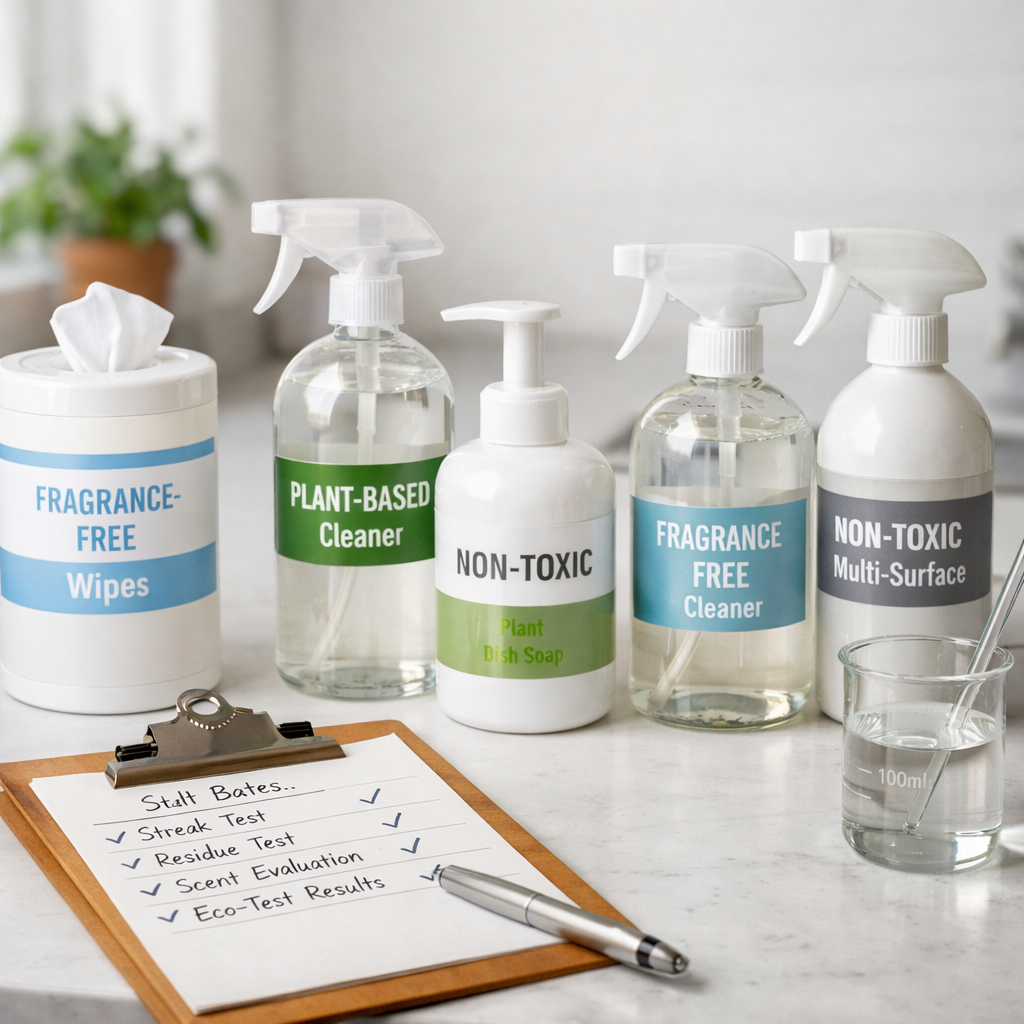
Simple at-home residue test: Spray on glass/stainless, wipe with microfiber, allow to air-dry, then inspect for film/streaking under angled light. Repeat for three cycles on the same spot to observe potential buildup or softening. These are the same controls we use in our field trials.
Frequently asked questions
Are eco cleaners as effective as traditional disinfectants?
It depends on the product; plant-based cleaners can reduce VOCs and handle everyday soil, but only EPA-registered disinfectants can claim germ kill. Cleaning Supply Review recommends checking the EPA number and dwell time [cited: eco cleaners roundup; top multisurface cleaning solutions].
What certifications indicate safer ingredients and verified claims?
At Cleaning Supply Review, we look for full ingredient disclosure and credible eco labels (e.g., EWG Verified); for disinfection, the EPA registration number is the key verification [cited: natural, non-toxic products; eco cleaners roundup].
How do I verify an EPA disinfectant and its dwell time?
Confirm an EPA registration number on the label, review the pathogen list, and keep the surface visibly wet for the listed dwell time; this is a core control in our field checks [cited: top multisurface cleaning solutions; 2026 commercial cleaning guide].
What’s the safest way to use disinfectants on sensitive surfaces?
Check the label/SDS for material compatibility, use microfiber, mix at the correct dilution, and spot-test first—the same steps we validate in testing [cited: 2026 commercial cleaning guide].
How can I run simple at-home tests to check residue and performance?
Use a glass/stainless streak test, repeat applications to check buildup, compare microfiber vs. cotton passes with equal strokes, and time-on-task for consistency; these are the quick checks we rely on in reviews [cited: 2026 commercial cleaning guide].
Frequently Asked Questions
Are eco cleaners as effective as traditional disinfectants?
At Cleaning Supply Review, we find eco cleaners excel at soil removal and lowering VOCs, while only EPA-registered disinfectants can make germ-kill claims.
What certifications indicate safer ingredients and verified claims?
At Cleaning Supply Review, we trust full ingredient disclosure and credible eco labels (e.g., EWG Verified); for germ kill, confirm an EPA registration number.
How do I verify an EPA disinfectant and its dwell time?
Locate the EPA registration number and pathogen list on the label and keep surfaces visibly wet for the listed dwell time; that’s our baseline check, too.
What’s the safest way to use disinfectants on sensitive surfaces?
Verify compatibility on the SDS/label, use microfiber, follow dilution and dwell time, and spot-test—this mirrors our test guidance.
How can I run simple at-home tests to check residue and performance?
Run a glass/stainless streak test, assess buildup after repeated cycles, and compare microfiber vs. cotton with equal passes—the quick checks we use in reviews.