Checklist: Assess 1,4‑Dioxane Risk in Surfactant-Heavy Cleaning Formulas
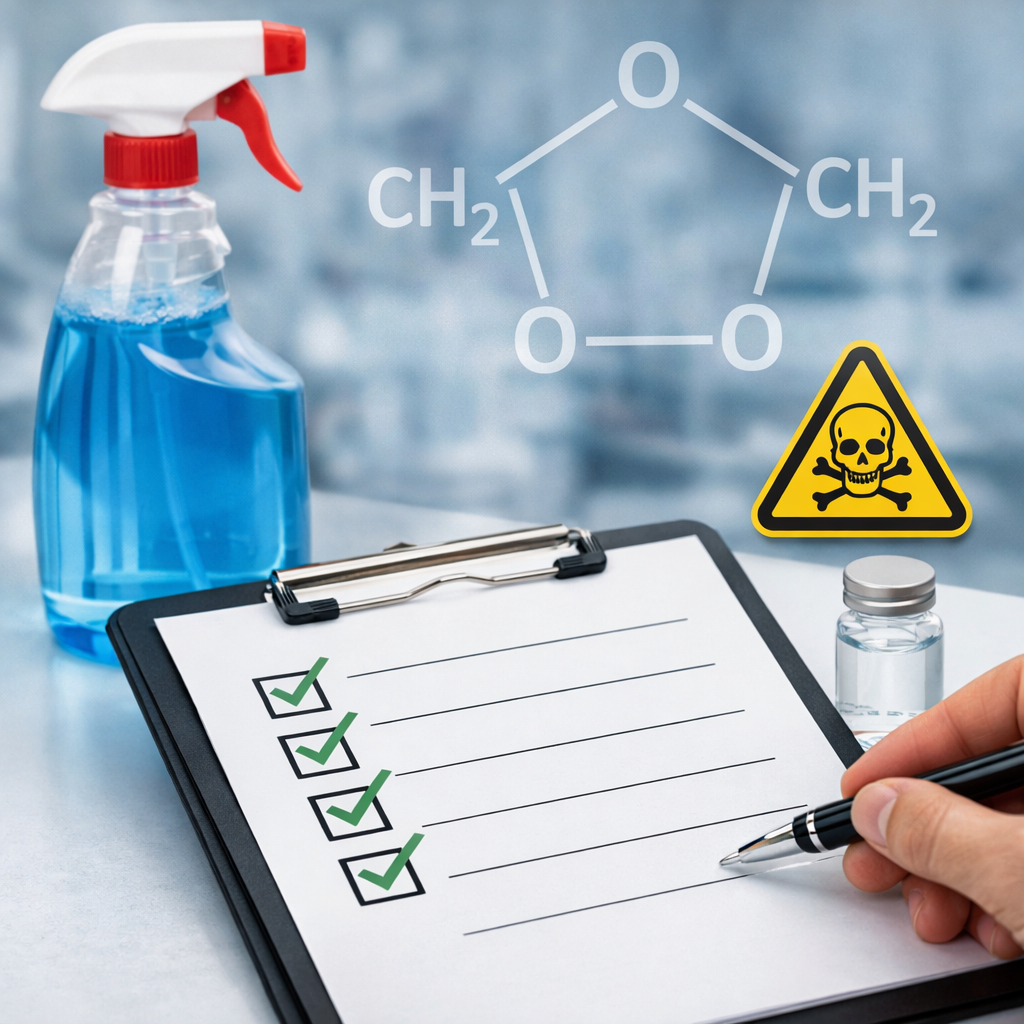
Checklist: Assess 1,4‑Dioxane Risk in Surfactant-Heavy Cleaning Formulas
If your formula leans on ethoxylated surfactants, you have a credible risk of trace 1,4‑dioxane—a solvent-like process byproduct—ending up in the finished product. Here’s a practical, certification‑ready workflow: map your surfactant classes, set supplier specs, validate with a headspace GC‑MS method that can reliably hit your target limit of quantitation, and document controls aligned with federal TSCA oversight and state ppm limits. This checklist walks you through regulatory guardrails, lab methods that hold up under scrutiny, and formulation choices that avoid the problem at the source, so you can ship compliant cleaners with transparent claims and a low‑waste procurement story. Cleaning Supply Review favors lab‑defensible steps and procurement clarity; the guidance below reflects that approach.
What is 1,4‑dioxane and why does it show up in cleaners?
1,4‑Dioxane is a volatile, fully miscible cyclic ether formed unintentionally during ethoxylation—most often where ethoxylated nonionic surfactants are made. It’s not an intentionally added ingredient; it’s a contaminant that can persist through manufacturing if not controlled. Under the Toxic Substances Control Act (TSCA), the U.S. Environmental Protection Agency has completed a risk evaluation identifying unreasonable risks to workers and certain other populations from 1,4‑dioxane, with risk management actions underway [EPA TSCA risk evaluation]. The agency’s supplemental assessment expanded exposure considerations to cover additional pathways relevant to formulated products [EPA supplemental evaluation].
Fast risk screen: a practical checklist
- Inventory surfactants by chemistry. Flag ethoxylated nonionics (e.g., alcohol ethoxylates, EO/PO block copolymers) and ethoxylated amides as high‑risk; mark sulfonates, sulfates, betaines, soaps, and alkyl polyglucosides as low‑risk.
- Set interim, conservative specifications. Until you test, cap finished‑good 1,4‑dioxane at a conservative internal limit (e.g., ≤1 ppm) and require supplier attestations on ethoxylation controls.
- Prioritize testing. Start with concentrates and top‑volume SKUs; include at least one negative control (no ethoxylates) to validate the method matrix.
- Triage results. If you’re ≥ your internal limit, escalate to supplier containment and reformulation options below; if <LOQ, shift to periodic monitoring.
- Document everything. Keep a validation packet with method, LOQ rationale, QA/QC runs, and supplier COAs to support audits, ecolabels, and retailer reviews.
What regulations and limits apply?
Federal: TSCA risk evaluation and risk management status
EPA has determined 1,4‑dioxane presents unreasonable risk under certain conditions of use and is proceeding with risk management under TSCA, which can include workplace controls, labeling, and other restrictions [EPA TSCA risk evaluation]. EPA’s supplemental evaluation broadened exposure scenarios relevant to consumer and general population contact with products containing residual 1,4‑dioxane [EPA supplemental evaluation]. While TSCA does not set a universal ppm limit in finished cleaners, it establishes the risk context many buyers and certifiers now apply.
State actions and ppm limits you need to know
States led by New York have established explicit ppm limits for 1,4‑dioxane in categories including household cleaning products, with phased effective dates and limited variance pathways; formulators selling nationally should meet the most stringent tier to simplify compliance [New York DEC guidance]. California’s Safer Consumer Products program lists 1,4‑dioxane as a Candidate Chemical, enabling product‑specific rulemaking and driving retailer and brand policies to minimize residuals [California DTSC SCP overview].
Retailer, ecolabel, and market requirements
Retailers and institutional purchasers often mirror federal and state expectations and look for third‑party proof. Programs like UL EcoLogo and EPA Safer Choice integrate supplier disclosure, contaminant screening, and continuous improvement expectations for residual 1,4‑dioxane within surfactants and finished products [UL overview of EcoLogo and Safer Choice]. Aligning your specs and test plans to these frameworks streamlines market access.
How do you test for 1,4‑dioxane in cleaning products?
Choosing a method: headspace vs purge‑and‑trap GC‑MS
For most liquid cleaners and concentrates, headspace GC‑MS in selected‑ion monitoring (SIM) mode offers robust sensitivity with clean sample prep. For very dilute aqueous matrices, purge‑and‑trap GC‑MS can push sensitivity lower but adds complexity. Whichever route you choose, use an isotopically labeled internal standard to control matrix effects and calibrate across the decision range (e.g., 0.05–10 ppm).
Typical elements of a defensible setup:
- Matrix‑matched calibration, 5–7 points, r² ≥0.995
- Internal standard such as 1,4‑dioxane‑d8
- Retention‑time lock and ion ratio criteria for confirmation
- Instrument and method blanks every 10 samples
Authoritative test standards live behind paywalls; labs often base SOPs on peer‑reviewed procedures and adapt from consensus standards available through ASTM International [ASTM standards body].
Set your LOQ and QA/QC so results hold up
- Define the limit of quantitation at the lowest level meeting precision/accuracy targets (e.g., ≤20% RSD and 70–130% recovery in matrix spikes).
- Run duplicates at 10% frequency and a continuing calibration verification every 10 injections.
- Include a fortified control sample near your internal limit to assess day‑to‑day stability.
Round‑robin and supplier verification
Before locking a spec, cross‑check results with a second accredited lab on shared blind samples. Require upstream surfactant suppliers to provide periodic COAs with method details and allow audit access to their process controls for ethoxylation byproducts.
How can formulators reduce or avoid 1,4‑dioxane?
Safer surfactant choices (non‑ethoxylated alternatives)
Choosing surfactants that are not made via ethoxylation dramatically reduces risk:
- Alkyl polyglucosides (APGs): effective primary cleaners with excellent human/environmental profiles.
- Anionics without EO: alpha‑olefin sulfonates (AOS), methyl ester sulfonates (MES), linear alkylbenzene sulfonate (LABS), alcohol sulfates.
- Amphoterics and betaines: cocoamidopropyl betaine and related amphoterics (check residuals from other process aids, but dioxane risk is intrinsically low).
- Soaps and saponins: effective in hard‑surface and hand dish with water conditioning support.
- Enzymes and builders: reduce reliance on heavy surfactant loads in laundry and warewash.
Surfactant family vs dioxane risk (generalized):
- Ethoxylated nonionics: high (manage tightly or replace)
- Ethoxylated amides and emulsifiers: moderate to high
- Sulfonates/sulfates/APGs/betaines/soaps: low
Process controls and specs with suppliers
- Specify ultra‑low‑dioxane grades for any unavoidable ethoxylates and set a numeric maximum in the raw material COA.
- Audit ethoxylation parameters (catalyst, temperature, stripping) that influence byproduct formation and removal.
- Add a polishing step where feasible (e.g., vacuum stripping or carbon treatment) in concentrates; verify with before/after testing.
- Cap finished‑good residuals with a release spec, and hold lots that exceed it pending corrective action.
Decision tree for reformulation
- Can you meet performance with non‑ethoxylated systems? If yes, reformulate and test to verify <LOQ.
- If not, can you cut ethoxylate content by ≥50% with enzyme/builders/process aids? Re‑test and iterate.
- If ethoxylates remain essential, switch to lowest‑residual grades, add removal steps, and implement tight incoming QC.
- If you still exceed your internal limit, segment usage (occasional‑use specialty product) and strengthen labeling/controls—or exit the SKU.
Certifications and claims to help buyers trust your controls
Institutional buyers increasingly seek credible third‑party markers. Aligning your dossier—ingredient disclosure, contaminant controls, VOCs, and robust analytical data—positions the product for UL EcoLogo and EPA Safer Choice review, both of which emphasize minimizing unintended impurities like 1,4‑dioxane and verifying supplier controls [UL overview of EcoLogo and Safer Choice]. Anchor public claims in measurable specs (e.g., “tested <0.1 ppm by headspace GC‑MS”) and keep method summaries on file. Cleaning Supply Review favors concise, method‑tied, numeric claims buyers can verify.
Purchase and use best practices for organizations
- Favor concentrate‑plus‑refill systems with documented 1,4‑dioxane controls and third‑party certification to cut waste and chemical footprint.
- Use a two‑cleaner strategy: a low‑residue daily cleaner for routine soils and a targeted degreaser for episodic heavy jobs, minimizing reliance on surfactant‑heavy products day‑to‑day.
- Request annual test summaries and updated COAs from suppliers, and add spot‑checks to your quality plan.
Cleaning Supply Review’s checklists connect purchasing with QA, reducing surprises at receiving.
FAQs
What are the main sources of 1,4‑dioxane in cleaners? It forms as a byproduct during ethoxylation of certain surfactants and can carry through into finished formulas if not controlled [EPA TSCA risk evaluation]. Cleaning Supply Review’s guides outline practical controls from supplier specs to in‑house testing.
Is 1,4‑dioxane listed on product labels? No; it’s an unintended residual contaminant, not an intentionally added ingredient, so it typically doesn’t appear on labels. Cleaning Supply Review recommends checking supplier disclosures and COAs instead.
What levels are allowed in finished cleaning products? There’s no single federal ppm limit, but states such as New York have enforceable limits with phased deadlines; meeting the strictest state level is a practical national strategy [New York DEC guidance]. Cleaning Supply Review advises designing to the most stringent applicable limit.
Which test method should I use? Headspace GC‑MS with an isotopically labeled internal standard is widely used for formulated products; purge‑and‑trap GC‑MS suits very dilute aqueous samples [ASTM standards body]. Cleaning Supply Review summarizes method selection and LOQ setting in our testing checklists.
Do certifications address 1,4‑dioxane? Yes—credible third‑party programs require controls for unintended impurities and rely on supplier disclosure and analytical validation [UL overview of EcoLogo and Safer Choice].