Commercial Kitchen Drain Cleaning: Grease-Busting Solutions Facilities Trust
Commercial Kitchen Drain Cleaning: Grease-Busting Solutions Facilities Trust
Grease-driven backups are predictable—and preventable—when you use the right commercial kitchen drain cleaning solutions for grease. For hardened deposits and slow, multi-line issues, schedule hydro-jetting; for day-to-day prevention and odor control, dose a non-toxic, enzyme drain cleaner for restaurants upstream of traps. Pair those with tight source control, a 25% grease trap pumping schedule, and documented inspections to keep lines moving and regulators satisfied. Below, Cleaning Supply Review distills a safety-first, low-VOC, non-caustic playbook that blends mechanical cleaning, biological maintenance, and smart monitoring—so facilities cut downtime, avoid fines, and extend pipe life.
Why grease control in drains matters
FOG—fats, oils, and grease—are cooking byproducts that cool and solidify in pipes, forming dense sludge that narrows flow and triggers backups; in sewers they can combine with debris to form near-impenetrable fatbergs that require professional removal, raising costs and risk to operations (see hardened FOG and fatbergs). Missed grease trap maintenance and unmanaged FOG don’t just slow service—they can bring fines or temporary closures under local wastewater rules, health codes, and pretreatment ordinances (grease trap neglect risks). Regular schedules protect commercial kitchen drains, reduce unplanned downtime, and support regulatory compliance and environmental stewardship.
How FOG forms and where buildup hides
Commercial kitchens face elevated FOG risk because hot water, detergents, and food particles carry liquified grease farther before it cools and sticks to pipe walls; over time it solidifies into heavy sludge that blocks lines (grease progression in drains).
FOG hotspots to monitor:
- Floor sinks and floor drains (under equipment lines)
- P-traps and sink laterals (especially low-slope sections)
- Grease trap/interceptor inlets, walls, and baffles
- Downstream building laterals toward the main
- Any long run with bends, offsets, or sags
An integrated drain program for commercial kitchens
Strong programs blend source control, scheduled services, and documentation. Adopt daily scraping/screening, set trap pumping by the 25% rule, and schedule hydro-jetting and camera checks as needed; maintain logs for audits and inspections (compliance-focused grease programs).
Suggested cadence, roles, tools, and record-keeping:
- Daily (BOH staff)
- Scrape plates/pans to trash; use fine-mesh drain screens.
- End-of-service hot-water flushes on high-use lines (5–10 minutes).
- Log screens cleaned and any slow drains.
- Cost-per-use: drain screens <$0.02/day; hot-water flush negligible.
- Weekly (Shift leads)
- Enzymatic maintenance dose during low-flow periods.
- Inspect floor drains and trap lids for odors/overflow risk.
- Update maintenance log and note anomalies.
- Cost-per-use: enzyme dosing ~$0.10–$0.25 per drain/day (concentrates).
- Monthly/bi-monthly (Facilities)
- Grease trap visual check and service per 25% rule.
- Spot-snaking of small-diameter lines if localized slowdowns.
- Maintain service receipts and waste manifests.
- Typical services: trap pump $150–$400; localized snaking $100–$300.
- Quarterly/bi-annually (Professionals)
- Hydro-jetting of laterals with camera verification where needed.
- Update line map and refine intervals.
- Typical costs: jetting $400–$900 per visit; camera add-on $200–$500.
- Annually (Management)
- Program review: incidents, costs, compliance status, and training refresh.
- Calibrate usage-based intervals using logs and any sensor data.
Mechanical and hydraulic cleaning methods
Hydro-jetting uses high-pressure water to scour pipe walls and push debris to a recovery point; mechanical snaking (rodding) uses rotating cables/rods to bore through obstructions. Both outperform DIY chemical openers for restoring capacity, with jetting preferred for hardened grease and biofilm and often less operational downtime (innovative cleaning techniques). Cleaning Supply Review prioritizes mechanical restoration over harsh chemical openers in high-FOG settings.
Comparison of methods
| Method | Best For | Pros | Caveats | Typical Frequency | Downtime |
|---|---|---|---|---|---|
| Hydro-jetting | Hardened grease, scale, biofilm in medium/large lines | Restores near-original diameter; chemical-free; reaches full pipe wall | Requires cleanouts and trained techs; pre-inspect fragile lines | 6–12 months or as needed | 1–3 hours, often after-hours |
| Snaking/rodding | Localized obstructions, small-diameter lines | Fast, targeted, low setup | May leave wall deposits; pair with flushing/jetting | As needed | 30–90 minutes |
| Vacuum extraction (truck/wet-dry) | Traps, floor sinks, removing dislodged debris | Immediate removal; good with jetting | Limited wall cleaning | With trap service | 1–2 hours |
| Enzymatic/bio dosing (preventive) | Ongoing odor control and FOG reduction upstream | Non-caustic; low-VOC; cost-effective maintenance | Not a cure for hardened deposits; needs routine dosing | Daily–3x/week | None |
| Caustic/acid drain openers | Soft, minor organic clogs | Quick dissolving action | Not recommended for commercial kitchens—pipe damage, fumes, PPE and compliance risks | Avoid | N/A |
Hydro jetting for hardened grease and biofilm
High-pressure hydro-jetting scours hardened oil, food particles, and biofilm, restoring drainage effectively and typically reducing operational downtime when scheduled off-hours (jetting outcomes and scheduling). Guidelines:
- Pre-inspect with a camera, especially for older or fragile materials.
- Coordinate after closing and isolate zones to minimize service impact.
- Document pre/post flow or footage to validate results and refine intervals.
Definition: Hydro-jetting uses pressurized water streams through specialized nozzles to cut through grease, scale, and residues along pipe walls, restoring near-original diameter without harsh chemicals.
Professional snaking and rodding for targeted blockages
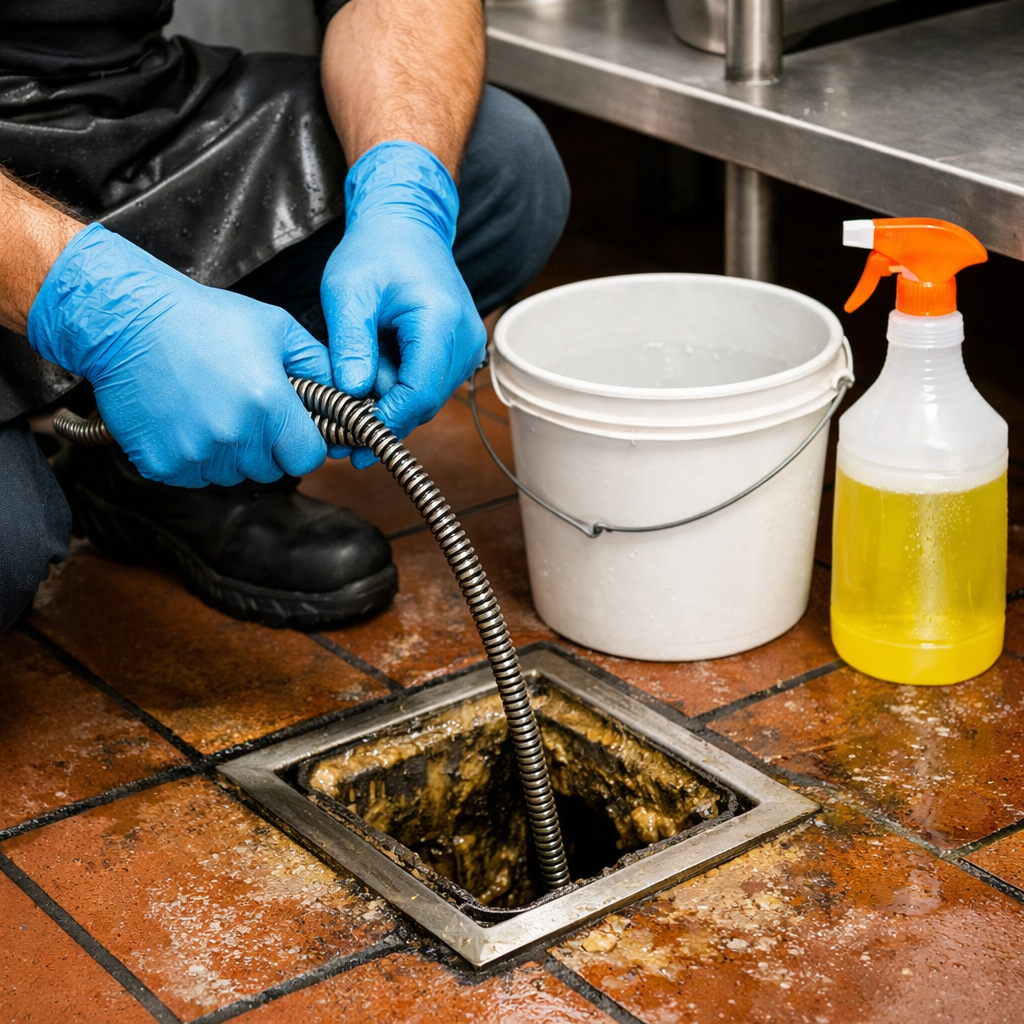
Snaking excels at clearing localized obstructions and smaller-diameter branches. It breaks up FOG plugs but may leave wall films; combine with follow-up flushing or scheduled jetting to slow re-accumulation and extend the time between callouts.
When to pair jetting with video inspection
Use video inspections to locate root intrusion, corrosion, offsets, sags, or damaged fittings before escalating cleaning. Capture pre/post footage to document condition, support budgeting, and fine-tune service intervals (camera inspections in commercial drains).
Grease trap and interceptor maintenance
Routine pumping and cleaning based on load—and especially the 25% rule—prevent overflows, odors, and downstream blockages. Professional services typically include inspection notes and receipts that support local compliance requirements (grease trap cleaning basics).
The 25 percent rule and service intervals
The 25% rule means pump when combined FOG and solids reach about one-quarter of liquid depth—often every 1–3 months in restaurants.
Suggested service frequency by kitchen volume
| Volume/FOG load | Typical operation | Suggested frequency | Notes |
|---|---|---|---|
| High | Quick service, fried-heavy menus, >300 covers/day | Monthly | Increase during peak/seasonal surges |
| Medium | Full-service mix, 100–300 covers/day | Every 6–8 weeks (bi-monthly) | Adjust for prep-intensive concepts |
| Low | Cafes/light prep, <100 covers/day | Quarterly | Verify against 25% measurements |
Maintain compliance logs with date, % fullness, hauler, volume removed, and tech initials.
Certified hauling, disposal, and documentation
Seal grease waste in leak-proof containers and transport only with licensed haulers to approved processors or rendering facilities; keep manifests and service receipts on file for inspectors. Local permits often require scheduled reporting—non-compliance risks fines or closures (service and compliance expectations).
Daily source-control and housekeeping
Frontline behaviors dramatically reduce FOG entering drains and extend service intervals. Standardize plate scraping, use fine-mesh screens at every sink and floor drain, and run end-of-shift hot-water flushes on high-use lines. Reinforce with a simple checklist and BOH signage, and hold shift leads accountable via logbook sign-off.
Plate scraping, drain screens, and hot-water flushes
- Do: Scrape to trash, not sink; install fine-mesh screens; empty screens into solid waste bins; flush drains with hot water after service.
- Don’t: Rinse fryer oil down sinks; bypass screens; ignore early slow-drain warnings. Mini-poster concept (back-of-house): 1) Scrape. 2) Screen. 3) Flush. 4) Log.
Waste handling, container liners, and staff training
Use heat-resistant liners for grease bins, seal lids, and store in a designated, spill-protected area. Align pickup schedules with production to prevent overflows. Train all staff on FOG practices, escalation cues, and documentation; supervisors sign the logbook daily.
Sustainable chemistries and biologicals
Enzyme-based and biological drain treatments can meaningfully reduce grease films and odors when dosed correctly, but they supplement—never replace—mechanical cleaning and trap pumping (preventive but not curative). Cleaning Supply Review shortlists neutral pH, fragrance-free formulas with full SDS transparency for facilities with fragrance-sensitive staff and guests.
Enzyme and bacterial treatments as preventive aids
Definition: Enzyme and bacterial drain treatments use non-pathogenic microbes and enzymes to digest fats and food residues into smaller compounds, reducing odor and slowing buildup without caustic chemicals. Dose during low-flow periods, target upstream lines and trap inlets, and monitor results (sensor data or visual checks) to adjust frequency.
What these products can and cannot do
Biologicals do not remove hardened deposits and cannot substitute for pumping or hydro-jetting of advanced buildup; use them to maintain lines between services. Avoid harsh chemical drain openers; prioritize non-caustic, low-VOC, fragrance-free formulas consistent with health- and fragrance-sensitive workplaces.
Monitoring and smart scheduling
Automation and smart tech now provide real-time data to optimize grease management—systems can automate cleaning steps, monitor trap levels, and improve separation efficiency (grease management technologies). IoT sensors and analytics reduce downtime and emergency cleanings; some platforms flag early buildup and corrosion so teams schedule predictive service, and operators report that good records and regular maintenance can cut plumbing costs by roughly 60% over time (usage-based savings and alerts). Cleaning Supply Review favors simple, auditable logs and sensors that integrate with existing workflows.
Camera inspections and baseline mapping
Begin with a camera survey to baseline condition, identify problem segments, and set targeted maintenance plans. Log:
- Pipe sizes and materials
- Bends, offsets, or known sags
- Cleanout locations and access notes
- Last service dates and findings
Simple baseline log
| Line segment | Diameter/material | Notable features | Cleanouts | Last inspected |
|---|---|---|---|---|
| Prep sink to trap inlet | 2" PVC | 2 bends, slight low spot | 1 at wall | MM/DD/YY |
| Trap to lateral | 3" cast iron | Scale on walls | At trap outlet | MM/DD/YY |
Sensors, alerts, and usage-based service frequency
Smart sensors can track flow, level, pressure, and temperature to warn of clogs and overfills; automated alerts prompt just-in-time service and prevent costly spills. Move from fixed to usage-based intervals to right-size spend and avoid premature service while protecting compliance.
Safer product selection criteria
Cleaning Supply Review recommends choosing solutions that are fragrance-free, low-VOC, non-caustic, and non-corrosive. Avoid strong bases/acids that can damage pipes and create inhalation risks. Favor ingredient transparency and credible third-party certifications, plus concentrates, refills, and reusable bottles to cut waste and cost-per-use.
Low-VOC, fragrance-free, non-caustic options
Select neutral pH, enzyme-based maintenance cleaners for routine dosing. Evaluate:
- Cost-per-use (aim for $0.10–$0.25 per drain/day in concentrate form)
- Scent intensity (prefer zero added fragrance)
- VOC content and packaging (refill pouches, tablets, reusable sprayers) Pair with a separate disinfectant for surrounding non-porous surfaces—never dose disinfectants into drains.
Certifications and ingredient transparency to verify
Review SDS and full ingredient disclosures. Look for third-party eco labels relevant to non-disinfecting products (e.g., EPA Safer Choice, UL Ecologo). For surface disinfectants near prep zones, verify EPA List N status; do not use disinfectants inside drains.
Budget and compliance case for preventive maintenance
A documented preventive maintenance plan—source control, 25% trap pumping, scheduled jetting, and smart monitoring—reduces emergency calls, closures, and fines; operators commonly realize plumbing cost reductions near 60% when they maintain good records and right-size intervals. Mini-ROI example (annual):
- Avoided emergencies (2 calls at ~$700 each) = $1,400
- Reduced downtime (4 hours saved at $300/hour service value) = $1,200
- Program costs (enzymes $400; jetting $700; sensors $300) = $1,400
- Net benefit ≈ $1,200, plus compliance and sanitation gains
Documentation checklist:
- Trap service logs with 25% measurements
- Hauler manifests and disposal receipts
- Camera reports and jetting invoices
- Daily/weekly housekeeping and dosing logs
- Training records and SOP sign-offs
When to call certified professionals
Call pros for recurring clogs, multiple slow drains, gurgling, or persistent odors across zones—these signs point to deeper FOG buildup requiring hydro-jetting, vacuum recovery, and possible video diagnostics. Combination services and professional tools keep kitchens compliant, safe, and sanitary while minimizing downtime (common mistakes and pro value).
Frequently asked questions
How often should commercial kitchen drains and grease traps be cleaned?
Most kitchens benefit from hydro-jetting or professional cleaning every 6–12 months, with grease traps serviced by the 25% rule—often monthly to quarterly depending on volume. Cleaning Supply Review recommends setting intervals from documented logs and measured trap levels.
What are the signs that grease buildup needs professional removal?
Recurring clogs, multiple slow drains, gurgling, and persistent odors indicate deeper FOG buildup that typically requires professional jetting and trap service. Cleaning Supply Review advises scheduling service as soon as these signs appear.
Is hydro jetting safe for older or mixed pipe materials?
Yes—when preceded by a camera inspection and performed by trained techs who adjust pressure and nozzle types to pipe condition. Cleaning Supply Review also recommends documenting pre/post footage.
Do enzyme or bacterial drain treatments replace pumping and jetting?
No. Biologicals help maintain lines and control odors between services, but they do not remove hardened deposits or substitute for trap pumping and hydro-jetting. Cleaning Supply Review positions these as preventive aids only.
Are chemical drain openers recommended for commercial kitchen lines?
Generally no. Caustic or acidic openers can damage pipes and only clear soft clogs; physical methods like hydro-jetting and snaking remove buildup more reliably. Cleaning Supply Review favors mechanical methods plus non-caustic maintenance dosing in commercial kitchens.