How to Choose Reliable All-Purpose Cleaners with Truly Safe Ingredients
How to Choose Reliable All-Purpose Cleaners with Truly Safe Ingredients
A reliable all-purpose cleaner with safe ingredients starts with transparency, verified chemistry, and right-fit performance. Prioritize products that fully disclose ingredients, list specific surfactants or soaps (not vague “fragrance” or “cleaning agents”), and carry credible certifications. Then match the product type—cleaner, sanitizer, or disinfectant—to the job, verify label directions, and choose low-VOC, refillable formats to reduce exposure and waste. For quick vetting, look for Safer Choice or EU Ecolabel signals, confirm any germ-kill claims via master labels or registries, and favor fragrance-free options if you have sensitivities. You can find strong, safe all-purpose cleaner options at Cleaning Supply Review, mainstream retailers, and brand sites; apply the checks below to select confidently, then shortlist the best fit for your home or facility.
Start with transparent ingredient lists
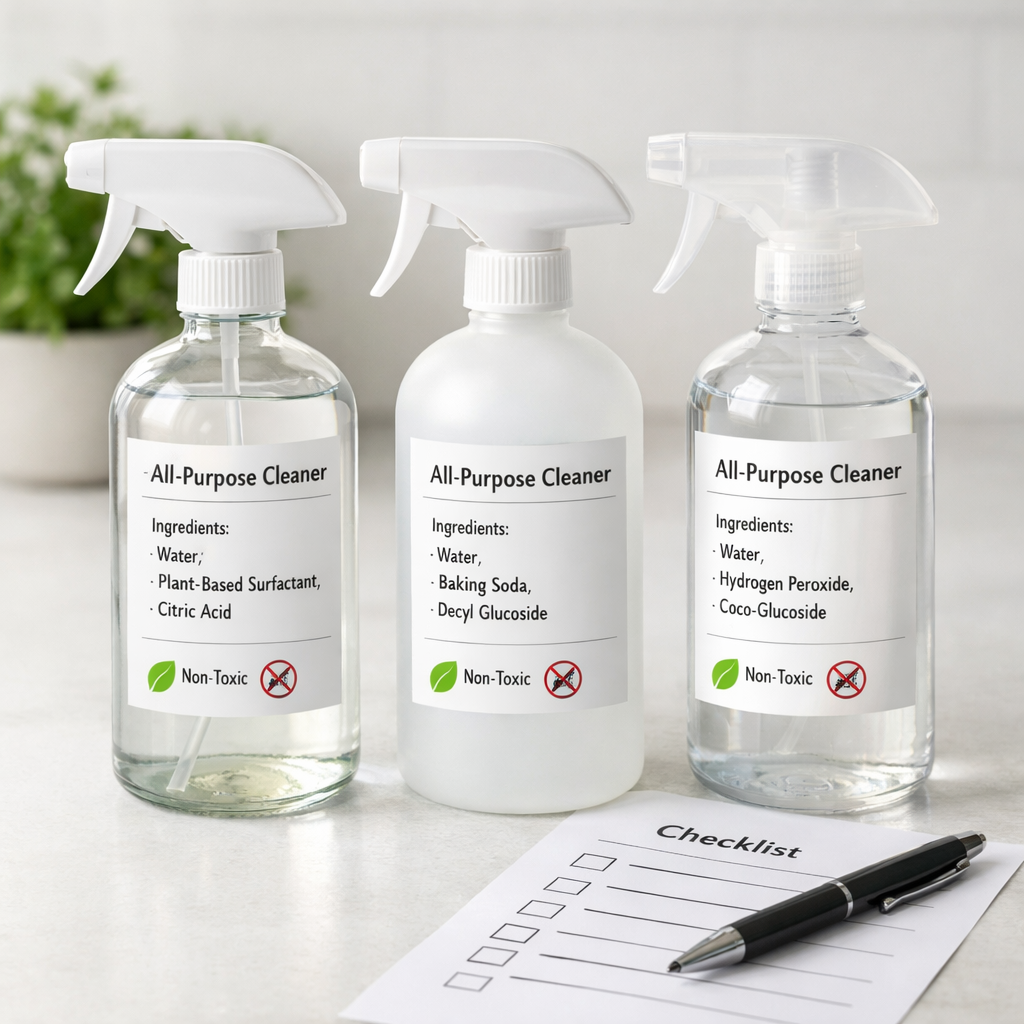
Read the ingredient panel first. Reliable products name their surfactants and solvents instead of using catch-all terms. Look for decyl, lauryl, or coco glucoside (plant-derived surfactants) and classic soap bases like sodium or potassium cocoate. Avoid vague labels that list only “fragrance,” “surfactants,” or “cleaning agents,” as advised in Consumer Reports’ guidance on healthier cleaning products (which also flags California’s online disclosure rule) Consumer Reports guidance on healthier cleaning products. Cleaning Supply Review favors products with full, named ingredient disclosure in our picks.
Definition — Plant-based surfactants (40–50 words) Plant-based surfactants are cleaning agents made from renewable feedstocks such as coconut, corn, or sugar. Common alkyl glucosides—like decyl, lauryl, or coco glucoside—lift soils and cut grease effectively, and they generally biodegrade more completely and predictably than many petroleum-derived surfactants in typical wastewater conditions.
A quick ingredient checklist:
- Look for named glucosides (decyl/lauryl/coco) and saponified plant oils (sodium/potassium cocoate).
- Prefer full ingredient lists and explicit fragrance disclosures; fragrance-free is best for sensitivities.
- Avoid for routine cleaning: quaternary ammonium compounds (quats), SLS/SLES, alkylphenol ethoxylates, phthalates, and bleach/ammonia on mixed surfaces.
Verify safety and performance certifications
Certifications simplify due diligence. EPA Safer Choice indicates each intentionally added ingredient passed a human and environmental safety screen; you can also search specific substances on the Safer Chemical Ingredients List to understand allowed chemistries EPA Safer Choice program.
Definition — Safer Choice (40–50 words) Safer Choice is a U.S. EPA program that screens every intentionally added ingredient for human and environmental hazards. Products must meet stringent criteria for toxicity, carcinogenicity, sensitization, and environmental fate, use safer functional classes, and disclose ingredients; the Safer Chemical Ingredients List helps formulators choose vetted, lower-hazard options.
Where available, the EU Ecolabel offers an additional benchmark that blends performance thresholds with environmental criteria and aligns safety communication with EU CLP frameworks overview of cleaning product regulations and EU CLP alignment.
Match cleaner type to the job
Most daily jobs simply need a cleaner to remove soil. Reserve germ-kill products for when they’re necessary, and follow label directions precisely (including keeping surfaces wet for the full dwell time) safer disinfecting practices and use guidance.
Type-by-type comparison
| Type | Everyday use-case | Regulatory status (U.S.) | Typical dwell time need | Example actives |
|---|---|---|---|---|
| Cleaner | Remove grease, dust, food soils | No germ-kill claims; not registered under FIFRA | Not applicable | Glucosides, soaps, mild solvents |
| Sanitizer | Reduce bacteria in kitchens/food-contact areas | EPA-registered if making kill claims | Often 30 seconds–2 minutes | Alcohols, lactic/citric acid |
| Disinfectant | Kill listed pathogens in high-risk settings | EPA-registered pesticide under FIFRA | Often up to 10 minutes wet | Hydrogen peroxide, ethanol, quats, citric acid |
When disinfection is required, choose products with registered claims and follow the master label. Common active thresholds include hydrogen peroxide (around 3% or higher), ethanol (about 70% or higher), or citric acid formulations with explicit organism claims. Never shortcut wet contact times.
Definition — Dwell time (40–50 words) Dwell time is the minimum time a surface must remain visibly wet with a disinfectant to achieve the organism kill claimed on its label. Depending on the product, this can range from one to ten minutes or more; always follow the master label’s directions for specific pathogens and surfaces.
Screen for low VOCs and safer pH
To protect indoor air, pick a low-VOC cleaner and, when solvents are present, prefer biobased ones. EPA’s greener purchasing guidance highlights signals like safer functional classes, lower volatility, and reduced aquatic toxicity identifying greener cleaning products.
For all-purpose performance, many frameworks evaluate cleaners around pH 9.3 ± 0.3; moving far above or below can increase irritation potential and surface risk, especially on coatings and stone EU performance test parameters for cleaners.
List and verify pH on the label or SDS, and always spot test on sensitive finishes.
Prefer concentrates and refill systems
Concentrates, tablets, and refill pouches reduce plastic and shipping weight while delivering the same cleaning power when diluted per label. Market roundups note strong, cost-effective refill options across categories editor-reviewed all-purpose cleaner picks. Refill systems are increasingly mainstream and cut plastic substantially versus single-use sprayers overview of refillable, non-toxic cleaner options.
Safe dilution labeling (for homes and facilities):
- Write the dilution ratio (e.g., 1:64), date mixed, and product name on the bottle.
- Note surface compatibility (e.g., “Not for natural stone”).
- Use dedicated, color-coded bottles; never mix chemistries.
Check preservatives and fragrance disclosures
If you’re sensitive, scrutinize the preservative system and choose fragrance-free. Some mass-market APCs use low-dose isothiazolinones (e.g., ~0.1% methylisothiazolinone/benzisothiazolinone), which are known sensitizers—avoid if you have eczema or asthma-prone occupants. Full fragrance disclosure is best; essential oils, if used, should be minimal and low-VOC. Thymol and pine oil can also be sensitizing for some users; assess carefully against needs and surfaces.
Validate claims with labels and registries
Definition — FIFRA (40–50 words) FIFRA is the U.S. law that regulates pesticides, which include disinfectants and any product making germ-kill claims. EPA registration requires approved master labels, efficacy data, and directions for use; marketing terms must match the label, and products must display an EPA Reg. No. verifying federal oversight.
Confirm any germ-kill claims on the product’s EPA master label, including wet dwell time and target organisms; consult EPA List N relevance when applicable. For ingredient transparency, check the manufacturer’s website—many brands provide full online lists due to state right-to-know laws (e.g., California). Where possible, Cleaning Supply Review links to master labels and public registries to streamline verification.
Test on surfaces and consider sensitivities
Before broad use:
- Spot test on an inconspicuous area and let dry; confirm no haze, etching, or color change.
- Start with the mildest dilution that cleans effectively; increase strength only as needed.
- Use microfiber to remove soil first; disinfect only when necessary.
For asthma or odor sensitivities, choose fragrance-free, low-VOC formulas and avoid routine quat exposure. For tough grime, pair a safe all-purpose cleaner with DIY adjuncts—baking soda for gentle abrasion and absorption; white vinegar for mineral buildup on non–acid-sensitive surfaces home guidance on safest cleaning choices.
Build a short list and compare total impact
Create a 3–5 product shortlist and compare side by side.
Comparison template (fill in for each product):
- Certification: Safer Choice / EU Ecolabel / none.
- Ingredient transparency: full list; fragrance disclosed; fragrance-free available.
- pH and VOCs: pH from SDS; VOC % if listed; any biobased solvents.
- Packaging: concentrate/tablet; refill availability; recycled content.
- Regulatory status: cleaner / sanitizer / disinfectant (EPA Reg. No. if applicable).
- Cost-per-use: dilution cost; refill price.
- Environmental signals: ready biodegradability (OECD); low aquatic toxicity (e.g., chronic EC50/LC50 >10 mg/L) when disclosed.
- Handling: viscosity or pourability notes (e.g., ~550 mPa·s at 20°C works well in trigger sprayers).
Want vetted examples? See our latest test-backed picks for safe, powerful all-purpose cleaners at Cleaning Supply Review.
Frequently asked questions
What makes an all-purpose cleaner’s ingredients truly safe?
Look for disclosed, plant-based surfactants (e.g., decyl or coco glucoside) and soap bases (sodium/potassium cocoate), with low-VOC, biodegradable formulas and third-party certification like Safer Choice. See Cleaning Supply Review’s ingredient checklist for examples.
Do all-purpose cleaners disinfect or just clean?
Most all-purpose cleaners remove soil but don’t disinfect. If you need germ-kill, choose an EPA-registered disinfectant and follow the master label, including full dwell time; Cleaning Supply Review flags these details in our disinfectant guides.
Which certifications indicate safer chemistry?
EPA Safer Choice and EU Ecolabel signal safer chemistry and environmental criteria. They review ingredient hazards and, for Safer Choice, align with the Safer Chemical Ingredients List; Cleaning Supply Review highlights products with these signals.
How do I read a label to avoid problem ingredients?
Favor specific surfactants (glucosides, saponified oils) and full ingredient disclosure. Steer clear of quats, SLS/SLES, bleach/ammonia for routine use, and products listing only generic terms like “fragrance” or “surfactant”; see Cleaning Supply Review’s label-reading tips for a quick scan.
Are concentrates and tablets as effective as ready-to-use sprays?
Yes, when diluted per label, concentrates and tablets clean as effectively as RTU sprays and reduce plastic waste. They often provide better value and simpler storage for homes and facilities, and we note dilution ratios and cost-per-use in our reviews.