How to Choose the Best Eco-Friendly Laundry Detergent Brand
How to Choose the Best Eco-Friendly Laundry Detergent Brand
Picking the best eco-friendly laundry detergent brand isn’t about a single “winner”—it’s about verifying safety, sustainability, and real cleaning performance that fits your washer, water temperature, and skin. At Cleaning Supply Review, our test-forward approach combines lab-and-field stain-by-fabric trials with certification lookups and packaging analysis so you can buy once and buy right. Start by confirming biodegradable, plant-derived ingredients and third-party certifications, then check cold-water and HE performance, packaging waste, and the company’s transparency track record. Use the steps and tools below to compare top contenders and run a quick at-home validation. By the end, you’ll know exactly which company makes the best eco-friendly laundry detergent for your home—and why.
Start with verified ingredient safety
Eco-friendly laundry detergent uses biodegradable, plant-derived surfactants and avoids phosphates, chlorine, formaldehyde-releasers, and unnecessary synthetic fragrances or persistent preservatives; for a truly lower footprint, consider life-cycle impacts beyond the bottle as well (as summarized in independent testing roundups). See the best green laundry detergent criteria overview from Sustainable Business Magazine for how evaluators weigh these elements.
Ingredient transparency is non-negotiable. Check full ingredient disclosures via SmartLabel—manufacturers list ingredients (including fragrances down to 0.01%), and the listing or app often links to SDS, certifications, and recycling guidance, as Consumer Reports explains.
Watch-outs to avoid in non-toxic laundry detergent:
- Methylisothiazolinone and benzisothiazolinone (preservatives linked to sensitization and irritation).
- Sodium laureth sulfate (SLES), which can be contaminated with the byproduct 1,4-dioxane; even otherwise well-rated detergents may include SLES. See the ingredient safety notes in Gimme the Good Stuff’s 2024 guide.
- Vague “fragrance” without a component list; prefer fragrance-free detergent if you have sensitivities.
Prioritize brands that publish full ingredient lists and disclose function (e.g., surfactant, enzyme, preservative). Biodegradable surfactants and clearly labeled enzymes tend to improve performance without relying on harsh additives.
Best Green Laundry Detergent evaluation criteria • Consumer Reports on SmartLabel and eco claims • Non-toxic ingredient red flags
Confirm third-party certifications through official registries
Certifications help separate marketing from measurable safety and sustainability. Short, quotable definitions:
- “EWG Verified” confirms ingredient safety, contaminant testing, and transparency. See Green Llama’s certification summary.
- “EPA Safer Choice” assesses ingredient safety, environmental impact, and performance.
- “USDA Certified Biobased” indicates the percentage of renewable ingredients in a product.
- “EcoCert” evaluates renewable content, biodegradability, and manufacturing/supply-chain practices; The Unwaste Shop’s guide summarizes these standards.
- “Leaping Bunny” confirms no animal testing across the supply chain with audits.
Not all marks are equal. When possible, prioritize EWG Verified detergent and EPA Safer Choice. Always cross-check logos against official certification registries to confirm product scope, expiration dates, and—when applicable—chain-of-custody coverage for ingredients and packaging; we verify this in Cleaning Supply Review’s product reviews.
Certification summaries (EWG, Safer Choice, USDA Biobased) • EcoCert and Leaping Bunny overviews
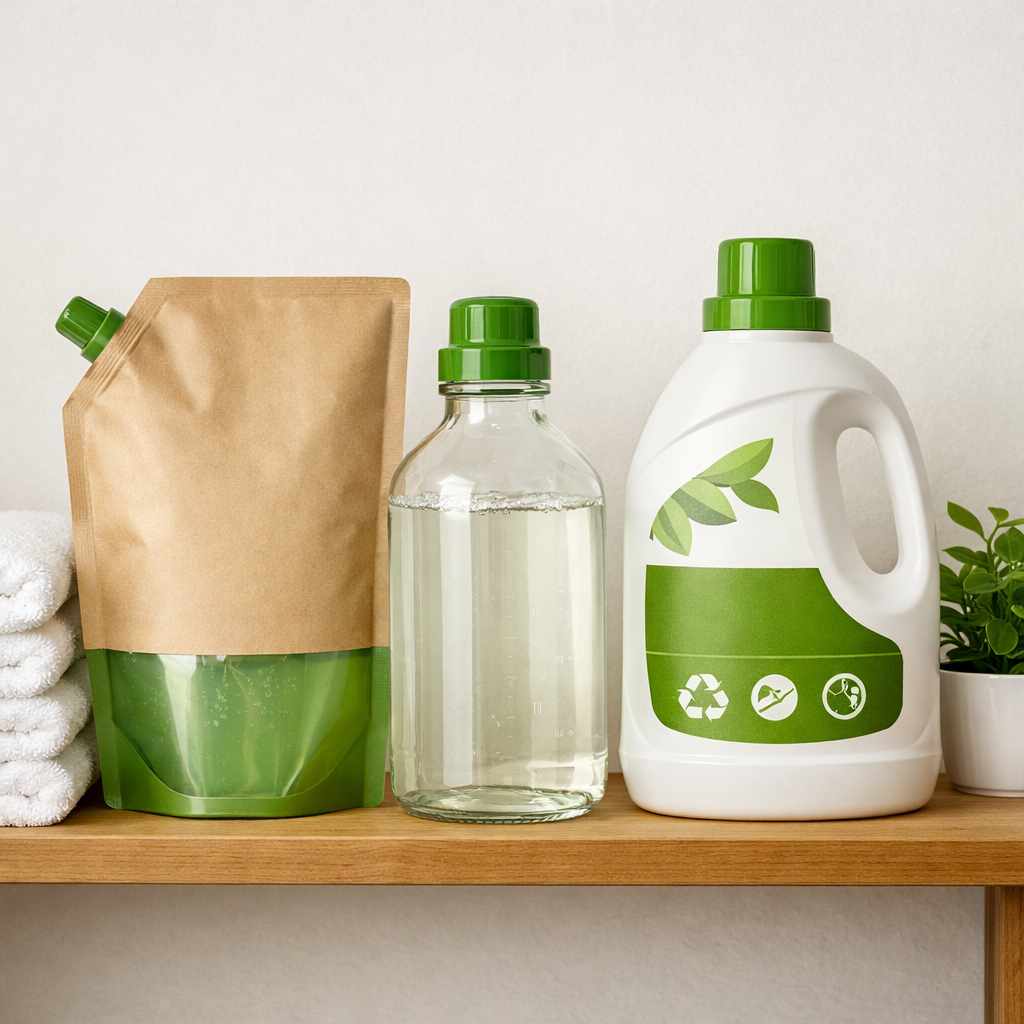
Evaluate packaging, concentration, and refill systems
Choose formats that cut plastic and carbon without sacrificing cleaning:
- Favor concentrated detergent formats, refill packs, and reusable bottles. Some sellers report subscriptions can save around 20% on refills, making lower-waste choices more affordable, according to Bower Collective.
- Packaging assessments look for recycled/minimal materials; several brands now offer reusable or refillable capsules, including hypoallergenic formulas, noted in independent best-of testing.
- Scrutinize packaging claims. For instance, some products advertise “70% less plastic vs traditional bottles,” as highlighted in Rolling Stone’s eco-friendly roundup—use such claims to benchmark real reductions.
Look for plastic-free laundry detergent options (powders, sheets) or closed-loop refill systems, and weigh transport emissions: waterless formats ship lighter, lowering the carbon footprint. In Cleaning Supply Review’s evaluations, we weigh packaging-reduction claims against actual materials and shipping weight to reflect real-world impact.
Refill savings context • Example packaging claim (“70% less plastic”)
Check machine compatibility and cold water performance
HE-safe detergent matters if you own a high-efficiency washer: these machines need low-sudsing formulas to prevent residue and over-foaming. At Cleaning Supply Review, our lab tests simulate varied water temperatures and fabrics to confirm cleaning consistency and minimal residue in HE cycles, a focus echoed in independent reviews.
For energy-efficient washing, emphasize cold water performance. Roughly 90% of a washing machine’s energy use goes to heating water, and washing at 30°C significantly cuts energy consumption, as noted in real-world eco-detergent reviews from Ethically Kate. Confirm “cold-water” claims on labels and consider quick pre-treat steps for oily or protein stains when washing cold.
Cold-water energy context and sheet dissolvability findings
Compare cleaning performance by stain type and fabric
To find the best eco-friendly laundry detergent brand for your laundry basket, match stain types to formats and boosters, then check fabric safety.
| Stain type | Best format/booster | Fabric notes | Residue risk |
|---|---|---|---|
| Oil/grease | Liquid or enzyme detergent; pre-treat; warm if label allows | Works well on cotton and synthetics | Low if well-rinsed; watch for overdosing |
| Protein (sweat, milk, blood) | Enzyme detergent; cold-to-warm; brief soak | Test on delicates; avoid hot water (sets protein) | Low; enzymes help prevent re-deposit |
| Tannin (coffee, tea, wine) | Oxygen bleach booster on whites; enzyme + cold on colors | Spot-test dyed fabrics first | Moderate if too much booster is used |
| Dye/transfer | Cold wash; color-safe formulas; avoid overload | Turn garments inside out; do not overfill | Low if load isn’t overcrowded |
At Cleaning Supply Review, our lab-and-field testing simulates different temperatures and fabrics, then inspects rinse water clarity, fabric feel, and any visible film. We also monitor wastewater impact indicators (e.g., foam persistence) to gauge ecosystem friendliness, consistent with third-party evaluation practices.
Review corporate transparency and multi-year reporting
A brand’s behavior should reinforce its product claims. Look for:
- Multi-year sustainability or CSR reports with year-over-year goals and progress.
- Product-level disclosures (e.g., SmartLabel) that match what’s in the bottle.
- Stated targets on packaging reductions, ingredient improvements, and verified updates annually.
Some rankings now incorporate life-cycle assessment data (production and transport carbon) and consumer surveys alongside lab results to reflect real-world satisfaction. For a broader view of who consistently delivers, see our most trusted cleaning brands ranking from Cleaning Supply Review and compare your shortlist against those transparency benchmarks. Our methodology prioritizes verified disclosures and year-over-year progress, not just marketing claims.
Cleaning Supply Review’s most trusted cleaning brands ranking
Validate claims with lab-and-field spot checks at home
Try this fast, reproducible at-home detergent test that mirrors the methods we use at Cleaning Supply Review:
- Pre-treat set stains (oil, protein, tannin) on cotton and polyester swatches.
- Wash in cold and warm cycles (HE if relevant) using label dosing.
- Score stain removal visually and with before/after photos in consistent lighting.
- Inspect rinse clarity and feel fabrics for any residue or stiffness.
- Note fragrance intensity and any skin response within 24 hours.
Robust testing tracks performance across temps/fabrics and observes wastewater qualities like sud level and clarity—your rinse inspection approximates this. Keep dosing consistent to avoid confounding results.
Balance format trade-offs with your use case and sensitivity needs
- Pods: Convenient and pre-measured, but many use PVA films and pose ingestion risks to children and pets, as consumer guides note.
- Powders: Waterless and often plastic-free; great for shipping efficiency, but measuring can be messy.
- Tablets: Waterless and pre-measured; may dissolve slowly in cold water depending on formulation.
- Sheets: Plastic-free, pre-measured, and designed to dissolve in cold and warm water; several reviewers report reliable cold-water dissolvability.
If you have sensitive skin, favor hypoallergenic, fragrance-free options and verify with certification logos and full ingredient lists. Some brands now pair refillable systems with hypoallergenic formulas to cut waste and irritation potential.
Make a small-scale trial and track outcomes
Before subscribing or buying bulk, run a 5–10 load pilot:
- Start with a small size or refill to gauge cost per load, cleaning strength, scent tolerance, and residue.
- Log data: stain type, water temp, machine type, dose, visible result, skin response, and any residue.
- Treat it like your own mini consumer survey to complement lab claims and marketing.
Simple performance log template:
| Load | Stain/type | Temp | Machine | Dose | Result (1–5) | Skin response | Residue | Est. cost/load |
|---|---|---|---|---|---|---|---|---|
| 1 | ||||||||
| 2 | ||||||||
| 3 |
Frequently asked questions
What makes a laundry detergent eco-friendly?
It uses biodegradable, plant-derived ingredients, avoids phosphates and harsh preservatives, reduces plastic via concentrates or refills, and backs safety with rigorous third-party certifications; reliable cold-water and HE performance lowers overall impact. Cleaning Supply Review’s test-based guides help you verify these quickly.
Which detergent format is most sustainable in practice?
Powders and sheets are often most sustainable because they’re waterless and frequently plastic-free, cutting transport emissions and packaging. In Cleaning Supply Review’s evaluations, waterless formats tend to have the lowest packaging and shipping impact, while concentrated liquids in refill systems are a strong alternative for oily stains.
How do I know a detergent is safe for sensitive skin?
Choose fragrance-free, hypoallergenic formulas, confirm full ingredient lists via tools like SmartLabel, look for strict certifications, and run a one-week at-home trial to ensure no irritation. Cleaning Supply Review flags these options and highlights transparency in our reviews.
Do eco-friendly detergents clean well in cold water?
Many do, especially HE-safe, low-sudsing formulas; confirm cold-water claims on the label and pre-treat oily or protein stains when washing at 30°C. Cleaning Supply Review tests cold-cycle performance and calls out consistent performers.
Are laundry sheets and pods truly plastic-free?
Sheets can be plastic-free, but many pods use PVA film and often come in plastic tubs; if you want plastic-free, favor powder or sheet formats and verify packaging and dissolvability claims before buying. Cleaning Supply Review checks PVA use and packaging disclosures in our reviews.