How to Qualify PVA Vendors: COAs, GMP, and Traceability
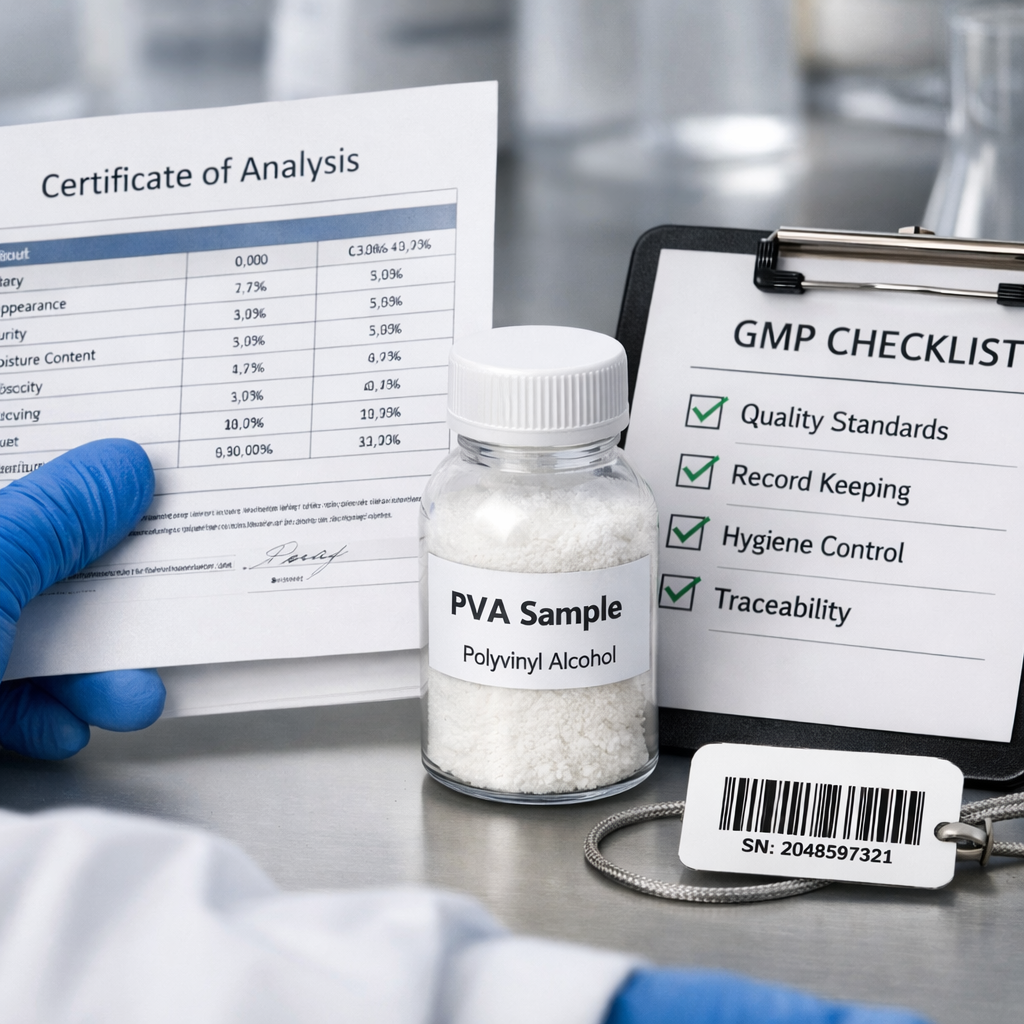
How to Qualify PVA Vendors: COAs, GMP, and Traceability
Consistent polyvinyl alcohol (PVA) is the difference between clear, residue‑free cleaner pods and returns caused by slow dissolve, gelling, or odor complaints. If you’re asking where to buy polyvinyl alcohol with consistent batch quality, start by qualifying vendors on three pillars: verified Certificates of Analysis (COAs), demonstrable GMP-quality controls, and end‑to‑end traceability. This Cleaning Supply Review guide shows procurement and quality teams how to set risk‑based requirements that work for low‑VOC, fragrance‑free consumer cleaners and scale into food‑ or pharma‑adjacent use cases. We anchor every step—specs, audits, eQMS/LIMS, and Part 11 controls—to practices regulators and retailers expect, so your batches perform the same on day 1, 100, and 1,000.
Why consistent PVA quality matters for safer, low‑VOC cleaning
Polyvinyl alcohol is a water‑soluble polymer supplied as PVA powder or pellets for films, detergents, thickeners, and adhesives. Grade selection (industrial, food‑grade, pharma‑grade) and batch consistency in viscosity, degree of hydrolysis, moisture, and residual monomers drive solubility, low‑residue cleaning, and low‑VOC profiles in sensitive, fragrance‑free products.
Supplier qualification is an extension of GMP: it requires active verification—documents, data integrity checks, and audits—not trust alone, per the Supplier Qualification Management guidance (https://www.qualityfwd.com/blog/supplier-qualification-management/). A risk‑based approach scales the rigor by material criticality and aligns with FDA/EMA expectations for supplier controls (https://assyro.com/blog/supplier-qualification-guide).
Define your use case and required PVA grade
Start with where and how the PVA will be used—skin‑contact cleaners, dissolvable refill films, or packaging—and translate that into measurable specifications and tolerances. Typical performance targets include:
- Viscosity (e.g., 4% solution at 20 °C): 3–6 mPa·s (pods) or 20–30 mPa·s (thickener); tolerance ±10%.
- Degree of hydrolysis: 87–89% (fast‑dissolve films), 98–99% (higher chemical resistance); tolerance ±1%.
- Moisture: 3–6%; tolerance ±0.5–1.0%.
- Film dissolution time at use temperature: ≤90 seconds; tolerance +15 seconds.
- Residual vinyl acetate monomer: as low as achievable; set internal alert limits aligned to product sensitivity.
Grade and documentation expectations vary by scope. Industrial/household applications typically accept ISO 9001 with strong COA controls; food‑adjacent use tightens residuals and traceability; device/pharma‑adjacent work may require ISO 13485 and GMP‑aligned documentation depth.
Use‑case to target attributes and oversight
| Use case | Target attributes (examples) | Documentation level | Audit intensity |
|---|---|---|---|
| Household cleaner pods (skin contact possible) | 3–6 mPa·s; 87–89% hydrolysis; ≤90 s dissolve; low residual monomers | ISO 9001, batch‑specific COAs, e‑data | Medium |
| Dissolvable refill films (low‑waste) | Fast dissolve at 10–20 °C; narrow MWD for film strength | ISO 9001; change‑control transparency | Medium–High |
| Thickener for detergents | 20–30 mPa·s; 98–99% hydrolysis; tight moisture control | ISO 9001; method comparability | Low–Medium |
| Food‑/pharma‑adjacent packaging or excipient evaluation | Low residual monomers; trace metals controls; full traceability | ISO 13485 or GMP‑aligned package | High |
Classify vendor risk before you start
- Categorize suppliers by material criticality and volume to calibrate oversight: low‑risk suppliers may clear desktop review; high‑risk require full qualification, QA agreements, and periodic audits consistent with 21 CFR Part 211 expectations (https://assyro.com/blog/supplier-qualification-guide).
- Shortlist suppliers with acceptable risk profiles and involve QA, procurement, and regulatory stakeholders early to shorten cycle time (https://gmpinsiders.com/supplier-qualification-in-gmp/).
- Assign a single QA/procurement owner for continuity, escalation, and supplier feedback loops (same source as above).
Verify COAs against your specifications
Treat the COA as primary evidence—but verify lot specificity, test methods, acceptance criteria, and data integrity against your internal spec. Standardize the COA data format to speed review and trending (https://gmpinsiders.com/supplier-qualification-in-gmp/). Score suppliers 1–5 on documentation completeness and COA reliability, and keep those evaluations in a controlled record. When COAs are electronic, confirm trustworthy records and signatures consistent with 21 CFR Part 11 as described in Supplier Qualification Management guidance (https://www.qualityfwd.com/blog/supplier-qualification-management/).
Confirm batch specificity and test methods
- Require batch‑specific, lot‑numbered COAs and retain them with incoming inspection files (https://gmpinsiders.com/supplier-qualification-in-gmp/).
- Request the analytical methods and acceptance criteria; confirm method suitability or justify any method differences versus your release testing.
- Trend variability‑prone tests (e.g., viscosity, molecular‑weight distribution) to catch drift before it becomes a complaint.
Check critical attributes and acceptance criteria
- Verify critical attributes that drive real‑world performance and low‑VOC outcomes: viscosity, degree of hydrolysis, moisture, residual monomers, and particle size.
- Retain batch documentation and COAs as a standardized e‑data package for each shipment (https://gmpinsiders.com/supplier-qualification-in-gmp/).
- Use scorecards, tied to material criticality, to monitor drift and defect rates over time in line with risk‑based supplier management (https://assyro.com/blog/supplier-qualification-guide).
Validate electronic records and data integrity
- Confirm e‑records and e‑signatures meet 21 CFR Part 11 trustworthiness when data is electronic (https://www.qualityfwd.com/blog/supplier-qualification-management/).
- Use supplier‑management or eQMS tools to automate document control and audit scheduling (https://gmpinsiders.com/supplier-qualification-in-gmp/).
- Capture audit trails in LIMS/eQMS for any changes to specs, COAs, and results.
Confirm GMP and quality system controls
Expect evidence that the supplier’s processes produce compliant PVA lot after lot. Confirm alignment to relevant GMP/ISO standards for your scope (e.g., ICH/EU GMP, 21 CFR 211; ISO 9001/13485) (https://gmpinsiders.com/supplier-qualification-in-gmp/). Integrate supplier controls into your pharmaceutical quality system using recognized quality‑system concepts (https://www.isctglobal.org/telegrafthub/blogs/audrey-le/2022/02/01/lpc-snapshot-dec-2021). Classify audit findings as Critical/Major/Minor; Critical items typically disqualify a supplier until corrected (https://assyro.com/blog/supplier-qualification-guide).
Request certifications and supplier questionnaire
- Request current certificates (e.g., ISO 9001 or ISO 13485) that match the activities performed (https://www.qualityfwd.com/blog/supplier-qualification-management/).
- Deploy a structured qualification questionnaire to capture processes, controls, and compliance history (https://gmpinsiders.com/supplier-qualification-in-gmp/).
- Verify financial stability and that certificate scope aligns with your purchasing category and ISO 9001:2015 expectations (https://www.isctglobal.org/telegrafthub/blogs/audrey-le/2022/02/01/lpc-snapshot-dec-2021).
Assess change control, training, and contamination controls
- Confirm documented change control, deviation/CAPA, training, and cleaning/contamination controls are implemented and effective (https://gmpinsiders.com/supplier-qualification-in-gmp/).
- Feed supplier‑related deviations into your CAPA system and verify effectiveness during management review (https://www.labmanager.com/mastering-supplier-qualification-and-management-in-gmp-environments-a-practical-guide-for-laboratory-professionals-34063).
- Document requalification triggers (e.g., process changes, new site) in line with USP <1083> supply chain integrity (https://www.usp.org/sites/default/files/usp/document/supply-chain/apec-toolkit/USP%20GC1083.pdf).
Plan desktop review and audit when risk warrants
- Start with a desktop review; escalate to remote or on‑site audits for medium/high‑risk suppliers (https://assyro.com/blog/supplier-qualification-guide).
- Use qualification audits to verify GMP compliance against your internal requirements (https://gmpinsiders.com/supplier-qualification-in-gmp/).
- When travel is constrained, conduct remote assessments aligned to USP <1083> (https://www.usp.org/sites/default/files/usp/document/supply-chain/apec-toolkit/USP%20GC1083.pdf).
Establish traceability from lot to finished batch
Build an auditable chain from supplier lots to your finished goods so you can isolate issues in minutes, not days. Link supplier records to batch documentation, lot numbers, and COAs, then embed those controls in your QMS for long‑term consistency (https://gmpinsiders.com/supplier-qualification-in-gmp/). Larger operations can consider serialization and traceability software to support scale (https://chekkitapp.com/blog/reliable-pharma-serialization-traceability-software-for-manufacturing/).
Link supplier lots, COAs, and incoming inspections
- For every receipt, capture supplier lot ID, COA, and your incoming inspection results in a single controlled record (https://www.labmanager.com/mastering-supplier-qualification-and-management-in-gmp-environments-a-practical-guide-for-laboratory-professionals-34063).
- Require standardized e‑data packages from suppliers for consistency (https://gmpinsiders.com/supplier-qualification-in-gmp/).
- Map the physical flow:
- Receive and quarantine,
- Identity test/verify COA,
- Release to inventory,
- Issue to blending/film casting,
- Record consumption in batch record,
- Link finished batches to PVA lots for recall readiness.
Configure eQMS or LIMS for audit trails and recalls
- Use eQMS/LIMS to automate document control, audit scheduling, and supplier scorecards (https://gmpinsiders.com/supplier-qualification-in-gmp/).
- Maintain audit trails and link supplier deviations to CAPA for rapid root‑cause analysis (https://www.labmanager.com/mastering-supplier-qualification-and-management-in-gmp-environments-a-practical-guide-for-laboratory-professionals-34063).
- Ensure systems meet 21 CFR Part 11 expectations for electronic records and signatures (https://www.qualityfwd.com/blog/supplier-qualification-management/).
Lock in requirements with a quality agreement
Codify specs, change‑notification timelines, deviation handling, and audit rights in a signed Quality Agreement. Reference risk‑based controls consistent with pharmaceutical quality‑system concepts and set requalification cadence aligned to USP <1083>. Include data‑integrity clauses, COA formats, and retention requirements that meet 21 CFR Part 11 and your QMS.
Monitor vendor performance and requalify on triggers
Use supplier scorecards tied to material criticality and supply‑chain risk; track on‑time COAs, OOS rates, and change‑control performance. Re‑qualify high‑risk suppliers annually; low‑risk suppliers every 2–3 years, with immediate action for Critical findings or unexpected trends.
Documentation to retain for audit readiness
- Batch‑specific COAs linked to lot numbers and incoming tests
- Supplier questionnaire, risk classification, and approvals
- Audit reports, observations, and CAPA evidence
- Signed Quality Agreements and change‑control notifications
- Traceability logs linking supplier lots to finished batches
- Controlled electronic records with validated access and audit trails
Practical tips to avoid batch variability
- Dual‑source with matched specs; share trend charts and run method bridging to align viscosity and dissolution performance.
- Use multivariate process understanding and real‑time monitoring where applicable per the FDA PAT framework (https://www.fda.gov/media/71012/download).
- Apply change‑impact analysis with requirements traceability tools to determine which tests to repeat after supplier changes (https://visuresolutions.com/medtech-and-pharma-guide/best-requirements-management-and-traceability-tools/).
Where to purchase polyvinyl alcohol with consistent batch quality
Prefer manufacturers and authorized distributors that provide batch‑specific COAs, standardized e‑data, and support for eQMS/LIMS integrations so your traceability is seamless end‑to‑end (https://gmpinsiders.com/supplier-qualification-in-gmp/; see also Lab Manager guidance). For regulated or skin‑contact categories, choose suppliers with current ISO 9001/13485 certificates and demonstrable GMP alignment to 21 CFR 211 expectations. Low‑waste options—like dissolvable refill films and bulk/returnable containers—further reduce environmental load without sacrificing performance. These criteria mirror how Cleaning Supply Review assesses supplier reliability in our coverage.
Quick pre‑purchase checklist:
- Verify certificate scope and validity; confirm site and activities covered.
- Request sample COAs and test methods; compare to your spec.
- Confirm Part 11‑compliant e‑COAs and data exchange format.
- Assess audit readiness and agree on change‑notification timelines before volume orders.
Frequently asked questions
What GMP standards apply to PVA suppliers used in consumer and regulated products?
For consumer cleaners, ISO 9001 with robust process controls is common; for regulated uses, align with ICH/EU GMP and FDA 21 CFR 211, and ISO 13485 for device‑related applications. Cleaning Supply Review recommends documenting how each standard maps to your use case.
How do I verify a COA is authentic and matches my delivered lot?
Match the COA lot number to packaging, confirm methods and acceptance criteria meet your spec, and require signed originals or Part 11‑compliant e‑records. Reject mismatched or incomplete documentation.
What traceability records should I maintain for PVA lots and finished batches?
Keep supplier lot IDs, batch‑specific COAs, incoming inspection results, and links from each lot to finished batches, all with system audit trails for rapid investigations.
Do qualification expectations differ for food, pharma, and household-cleaner use?
Yes. Household cleaners rely on ISO 9001 and rigorous COA review; food and pharma escalate to GMP frameworks, deeper audits, and stricter data integrity aligned to material criticality.
When is an on‑site audit necessary versus a remote assessment?
Use on‑site audits for high‑risk or high‑volume suppliers, new sources, or after significant changes; remote assessments suit lower risk when evidence access is sufficient.