How to Verify Cleaning Formulations Meet Safer Soap Act Standards
How to Verify Cleaning Formulations Meet Safer Soap Act Standards
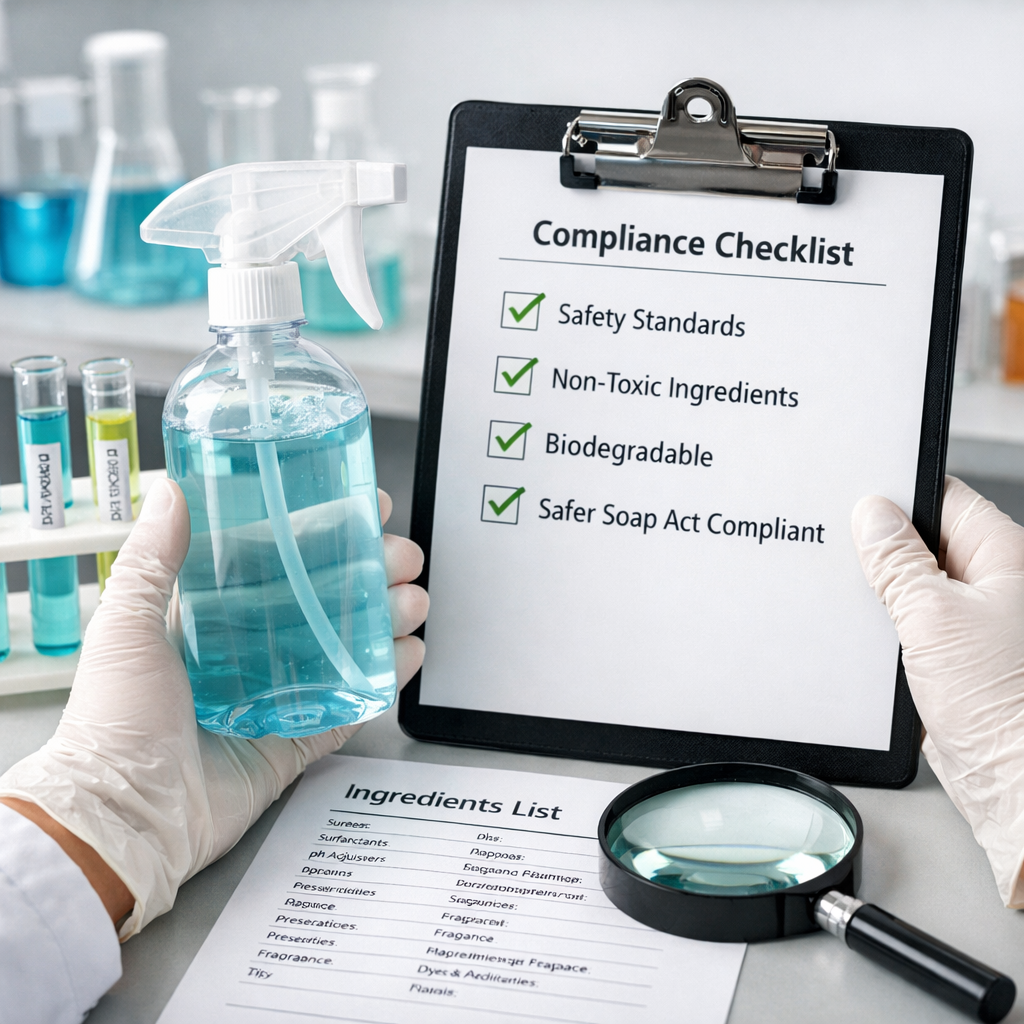
Verifying that a cleaning formulation meets Safer Soap Act–style standards starts with two things: official registry checks and defensible lab evidence. In practice, you’ll map what the product is (soap, detergent, or antimicrobial), screen its full ingredient list against trusted lists, and confirm low-residue performance with targeted testing. Then you validate labels and claims—especially anything implying disinfection—and compile an auditable dossier. This Cleaning Supply Review guide provides a step-by-step, standards-based roadmap to verify Safer Soap Act compliance for cleaning formulations using EPA Safer Choice, the SCIL list, GreenScreen Certified, GHS labeling, FIFRA registration, and cleaning validation methods.
Scope and definitions for Safer Soap Act compliance
“Safer Soap Act compliance refers to meeting state-level safer products rules (for example, restrictions on intentionally added PFAS in cleaning categories) while aligning with recognized safer chemistry frameworks such as EPA Safer Choice, GreenScreen Certified, and validated residue controls that prove effective cleaning without harmful leftovers.”
EPA Safer Choice evaluates every intentionally added ingredient against strict human health and environmental criteria and authorizes the label only when a product performs effectively and meets these benchmarks (see EPA Safer Choice) [https://www.epa.gov/saferchoice]. EPA’s Safer Chemical Ingredients List (SCIL) catalogs chemicals that meet Safer Choice criteria, helping specifiers identify safer functional ingredients by class [https://www.epa.gov/saferchoice/safer-ingredients]. GreenScreen Certified provides tiered certifications (Silver/Gold/Platinum) that require full material disclosure and restrict thousands of chemicals of high concern, expressly including PFAS and organohalogens (GreenScreen Certified) [https://www.greencleanerscreen.org/].
State-level safer product rules are often administered by agencies such as California’s Department of Toxic Substances Control (DTSC) through the Safer Consumer Products program, which prioritizes chemicals and product categories for action (DTSC) [https://dtsc.ca.gov/]. Clarify scope: under FDA, a product marketed solely as “soap” has a narrow legal definition distinct from cosmetics or drugs, and antibacterial claims change regulatory status (FDA soap) [https://www.fda.gov/cosmetics/cosmetics-laws-regulations/soap]. For hazard communication, GHS/CLP-driven labeling uses standardized hazard statements and pictograms that flag risks such as skin irritation or aquatic toxicity; verify labels and SDS align with these elements (GHS overview) [https://vapiorganic.com/blogs/guide-to-understanding-cleaning-products-regulations.html].
Assemble disclosures and product evidence
Build a complete evidence set up front to avoid rework:
- Require full materials disclosure (FMD), supplier SDSs, any prior lab test reports, and all labels/claims artwork.
- Capture product use category, VOC content, dilution and dwell-time instructions, GHS hazard statements/pictograms, and any antimicrobial claims that could trigger U.S. pesticide law oversight (FIFRA registration) [https://www.epa.gov/pesticide-registration].
- If available, save SmartLabel or transparency pages for batch-level ingredient disclosures and certification references (Cleaning Institute’s guide to labels and certifications) [https://www.cleaninginstitute.org/understanding-products/how-read-labels/cleaning-product-certifications].
Cleaning Supply Review requests this same documentation set during independent product evaluations to keep reviews traceable and auditable.
Map applicable standards and regulatory pathways
Translate scope into a standards map so your verification stays precise and defensible.
- Safer Choice/SCIL: Ingredient-by-ingredient evaluation for safer chemistry; check eligible functional classes and confirm any Safer Choice certification in the EPA’s listings.
- GreenScreen Certified: Requires full disclosure and bans high-concern substances (including PFAS/organohalogens); confirm certification tier and scope against the official registry.
- IPC‑1402: Greener cleaning agents for electronics assemblies; the CleanScreen app is commonly used to demonstrate conformance (see Tools & Standards) [https://www.chemworks.org/tools-standards].
- GHS/CLP labeling: Check that hazard statements, pictograms, and signal words match the SDS and actual formulation composition.
- Local VOC rules: Confirm product VOC content meets applicable regional or state limits for the use category.
- FIFRA (disinfectants/antimicrobials): If claims imply killing microorganisms, U.S. EPA registration and efficacy data (including dwell time) are required [https://www.epa.gov/pesticide-registration].
When antimicrobial claims appear anywhere (label, SDS, website), treat the product as potentially regulated under FIFRA and request EPA registration number and efficacy substantiation. Cleaning Supply Review verifies certification and registration status against authoritative public registries rather than marketing materials.
Screen ingredient hazards against trusted lists
Run each intentionally added ingredient and any residual monomers/impurities against credible lists and tools:
- Cross-reference the SCIL list to identify safer surfactants, solvents, and chelators [https://www.epa.gov/saferchoice/safer-ingredients].
- Use GreenScreen Certified criteria to quickly exclude chemistries on its restricted substances list, including PFAS and organohalogens [https://www.greencleanerscreen.org/].
- For full-disclosure hazard profiles and substitution analysis, use ChemFORWARD’s shared repository, which major brands have supported to expand ingredient transparency (ChemFORWARD) [https://scghub.org/].
Where electronics cleaning is in scope, align with IPC‑1402 and use tools such as CleanScreen to document conformance. Document all findings and unresolved questions before proceeding.
Set acceptance criteria and verification methods
Convert safer chemistry goals into measurable test-and-accept criteria.
- Define acceptance criteria up front (GMP-style cleaning validation). A simple matrix works:
| Category (Target) | Limit/Expectation | Test Method | Sampling Plan | Rationale |
|---|---|---|---|---|
| Residual organics (global) | TOC ≤ site-specific ppm threshold | TOC analysis | Swab + rinse, worst-case locations | Nonspecific screen for leftover organics; sensitive to small changes (APIC Guide) [https://apic.cefic.org/wp-content/uploads/2021/09/APIC_Cleaning-validation-guide_2021.pdf] |
| Specific actives/solvents | ND or below action level | HPLC/GC or targeted assay | Same swab sites + bracketing | Confirms removal of known risk actives; avoids false passes from TOC alone (APIC Guide) |
| Skin/eye hazard flags | GHS pictograms/phrases consistent | Label/SDS review | Artwork + SDS cross-check | Ensures hazard communication matches composition (GHS overview) [https://vapiorganic.com/blogs/guide-to-understanding-cleaning-products-regulations.html] |
| VOC content | Meets local category limit | VOC calculation/test | Certificate + periodic verification | Complies with regional air-quality rules |
| PFAS (high-risk categories) | Not intentionally added; TOF/targeted PFAS ND | Total organic fluorine or targeted PFAS | Ingredients + finished product as needed | Confirms alignment with PFAS restrictions and RSLs |
Total Organic Carbon (TOC) is a sensitive, nonspecific method for detecting residual organics after cleaning; pair TOC with targeted assays for actives or problematic solvents to prevent false passes (APIC Cleaning Validation Guide) [https://apic.cefic.org/wp-content/uploads/2021/09/APIC_Cleaning-validation-guide_2021.pdf]. Align responsibilities, methods, and pass/fail criteria before testing (Cleaning validation overview) [https://contractorplus.app/blog/cleaning-validation].
Execute laboratory testing and residue checks
Use a combined analytical approach:
- TOC for nonspecific organics, plus HPLC/GC or other targeted assays for known actives and sensitizers; validate analytical methods before use unless compendial (APIC Guide) [https://apic.cefic.org/wp-content/uploads/2021/09/APIC_Cleaning-validation-guide_2021.pdf].
- Apply swabbing and rinse-water analysis with validated recovery; FDA notes rinse-only sampling can miss insoluble or occluded residues, so direct surface swabs are essential (FDA Cleaning Validation 793) [https://www.fda.gov/inspections-compliance-enforcement-and-criminal-investigations/inspection-guides/validation-cleaning-processes-793].
- For complex equipment or large contact areas, increase representative sample points and plan routine monitoring with clear quality alerts (equipment cleaning validation guidance) [https://www.biopharminternational.com/view/equipment-cleaning-validation-within-multi-product-manufacturing-facility].
Validate performance and label claims
- If disinfectant or antimicrobial claims are made, verify U.S. EPA registration, efficacy methods, organism spectrum, and dwell times under FIFRA [https://www.epa.gov/pesticide-registration].
- Cross-check SDS versus labels so actives and quats aren’t disclosed in one place and omitted in the other; municipal guidance highlights gaps and safer alternatives (Safer disinfecting practices) [https://www.sfenvironment.org/sites/default/files/fliers/files/sfe_th_safer_products_and_practices_for_disinfecting.pdf].
- Contextualize hazards: pine oil cleaners can form secondary pollutants (e.g., formaldehyde) and bleach (sodium hypochlorite) carries high acute hazards; use safer chemistry frameworks to benchmark alternatives (same guidance above).
Compile documentation and pursue third‑party certification
Build an auditable dossier:
- Include FMD, SDS, hazard screening outputs (SCIL/GreenScreen/ChemFORWARD), validation protocols, method validations, lab results, label artwork, GHS alignment, and claims substantiation.
- Consider programs: EPA Safer Choice for ingredient-level review; SCIL for eligible functional classes [https://www.epa.gov/saferchoice/safer-ingredients]. GreenScreen Certified (Silver/Gold/Platinum) for full-disclosure hazard evaluation [https://www.greencleanerscreen.org/]. Consumer-facing marks like Green Seal and EWG Verified are widely recognized (Cleaning Institute overview) [https://www.cleaninginstitute.org/understanding-products/how-read-labels/cleaning-product-certifications].
Simple timeline checklist:
- Close data gaps (2–6 weeks). 2) Submit certification application (4–12 weeks review). 3) Address corrective actions and finalize labeling (2–8 weeks). Cleaning Supply Review verifies certification status in the issuing body’s public registry and cites the registry record in our reports.
Institute lifecycle controls and change management
- Establish a cleaning validation lifecycle: design, qualification (minimum three successful applications under worst-case conditions), and continued verification with periodic reviews (APIC Guide) [https://apic.cefic.org/wp-content/uploads/2021/09/APIC_Cleaning-validation-guide_2021.pdf].
- Monitor production and supplier changes, perform representative sampling post-change, and trigger quality alerts on nonconformance (equipment cleaning validation practices) [https://www.biopharminternational.com/view/equipment-cleaning-validation-within-multi-product-manufacturing-facility].
- Document revalidation triggers: supplier/raw material substitutions, equipment or process changes, updated hazard lists/standards (e.g., new PFAS listings) (FDA Cleaning Validation 793) [https://www.fda.gov/inspections-compliance-enforcement-and-criminal-investigations/inspection-guides/validation-cleaning-processes-793].
Plant‑based versus conventional performance thresholds
| Class | Typical Actives | Performance (Grease/Mineral/Protein) | Residue Risk | Applicable Certifications |
|---|---|---|---|---|
| Plant-based | Nonionic/APG surfactants, citrate, lactate | Strong on grease/protein; pair with mild acids for mineral | Low–moderate; verify with TOC/swab | Safer Choice, GreenScreen Certified |
| Conventional | Ethoxylates, quats, hypochlorite, glycol ethers | High on tough soils; watch corrosives/oxidizers | Moderate–high; requires targeted assays | Select SKUs can meet Safer Choice; many do not |
EPA confirms Safer Choice–certified products are both safer and effective when used as directed (Safer Choice) [https://www.epa.gov/saferchoice]. Regulatory shifts such as phosphate limits in dish formulations have driven surfactant system changes to reduce eutrophication, reshaping performance claims and ingredient choices (technical overview) [https://www.whitecatusa.com/Technical-Guide-to-Meeting-Global-Safety-Standards-for-Dishwashing-Detergents].
Stain and surface suitability, residue, and safety considerations
- Grease soils: favor nonionic surfactants; verify low residue via TOC plus surface swabs on non-porous coupons.
- Mineral scale: use mild acids on compatible surfaces; confirm GHS corrosive/irritant pictograms and PPE guidance on labels.
- Protein soils: enzymatic or alkaline builders; confirm rinseability and residue by TOC and targeted enzyme assays.
- Reminder: rinse-only sampling can miss insoluble residues; add direct swabs or coupons for verification (FDA 793) [https://www.fda.gov/inspections-compliance-enforcement-and-criminal-investigations/inspection-guides/validation-cleaning-processes-793].
“Surface-safe means a formulation cleans the target soils at labeled dilution without visible damage, corrosion, or film and leaves residues below pre-set analytical thresholds, verified by swab and rinse methods with validated recovery on representative materials.”
Field validation alongside lab results
- Pilot trials: combine visual inspection with analytical verification (swabs/rinses), recording recovery factors and pass/fail.
- Use bracketing/grouping to minimize duplicate validations for similar equipment or formulations; increase sample points for complex or large-surface assets (equipment cleaning validation best practice) [https://www.biopharminternational.com/view/equipment-cleaning-validation-within-multi-product-manufacturing-facility].
- Record dilution accuracy, dwell times, wipe/rinse technique, residue observations, and any slip-risk notes to mirror real custodial workflows (APIC Guide) [https://apic.cefic.org/wp-content/uploads/2021/09/APIC_Cleaning-validation-guide_2021.pdf].
How Cleaning Supply Review evaluates Safer Soap Act compliance
We apply a three-stage method. First, document review: FMD, SDS, and official registry checks (EPA Safer Choice, SCIL, GreenScreen Certified). We confirm GHS labeling, VOC disclosures, and whether antimicrobial claims require FIFRA registration. Second, lab-and-field testing: TOC analysis, targeted assays, and equipment swabbing/rinse sampling with validated recovery under worst-case conditions. Third, transparency assessment: we prioritize multi-year CSR reporting, full material disclosure, and certification records in official registries—not vendor PDFs. We also compare plant-based and conventional options and report when plant-based formulas meet performance thresholds, surface safety, and residue limits verified in lab and field. For brand comparisons and pricing context, see our rankings and benchmarks: Cleaning Supply Review’s most trusted brands [https://www.cleaningsupplyreview.com/posts/2025s-most-trusted-cleaning-brands-ranked-by-expert-reviewers/] and bulk antibacterial soap pricing benchmarks [https://www.cleaningsupplyreview.com/posts/2025-pricing-benchmarks-for-bulk-antibacterial-soap-gallons-to-cases/].
Frequently asked questions
What documentation proves a formulation meets Safer Soap Act requirements?
Provide full materials disclosure, supplier SDSs, hazard screening outputs (SCIL/GreenScreen/ChemFORWARD), validated test methods, lab residue results (TOC/swab), GHS-aligned labels, and certification records from official registries; Cleaning Supply Review’s reviews cite these sources directly.
How do I verify PFAS and other restricted classes are not intentionally added?
Screen all ingredients against GreenScreen restrictions and the SCIL list, obtain supplier attestations, and add total organic fluorine or targeted PFAS assays when risk is flagged with chain-of-custody maintained.
Which tests confirm low residue and surface safety after cleaning?
Use TOC for nonspecific organics plus swab and rinse sampling with validated recovery; include direct surface checks and compare results to predefined limits for each surface type.
When do disinfectant or antimicrobial claims trigger additional approvals?
In the U.S., almost any antimicrobial or disinfectant claim triggers FIFRA oversight; verify EPA registration, efficacy and dwell times, disclose actives, and align labeling before marketing.