How to Verify Safer Soap Act Compliance on Soap Labels
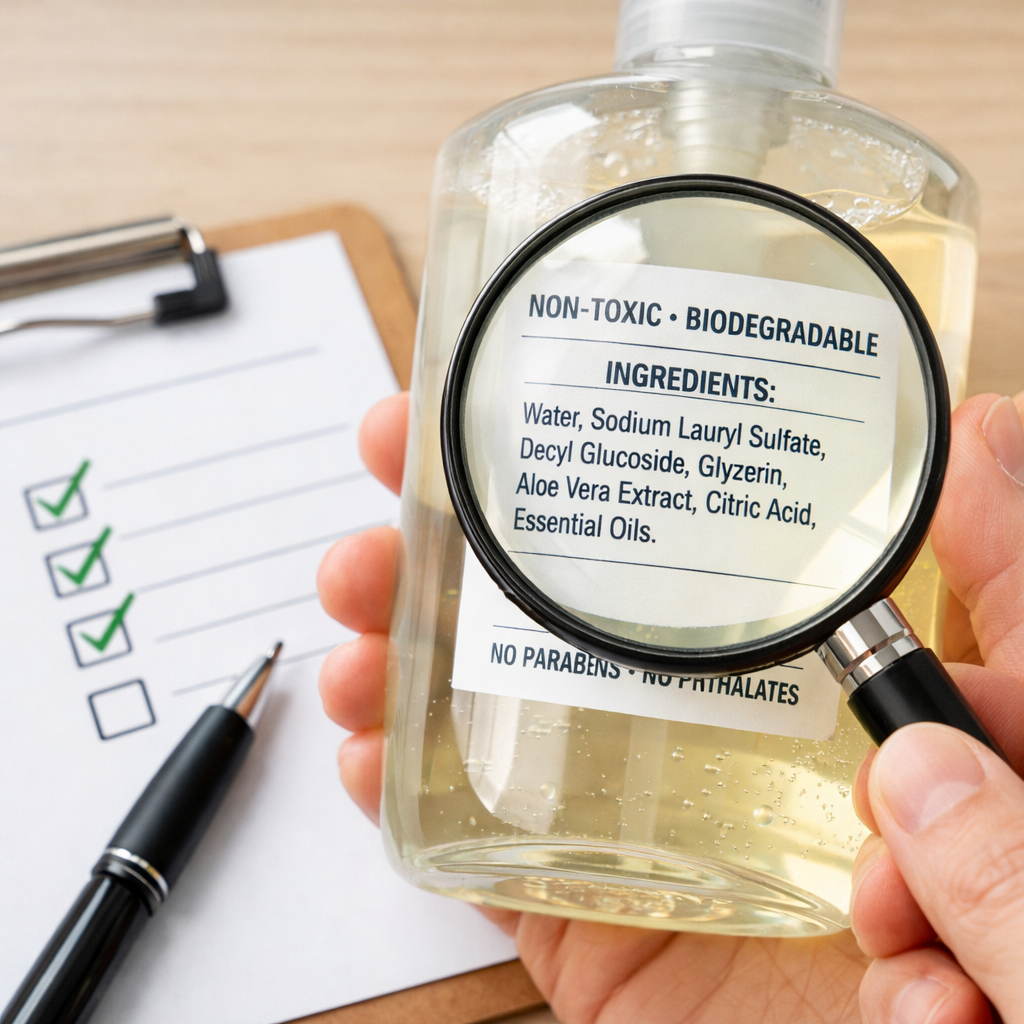
How to Verify Safer Soap Act Compliance on Soap Labels
A “Safer Soap Act” label isn’t a single federal certification. In practice, it refers to soaps that meet safer chemistry expectations (think EPA Safer Choice) and avoid restricted ingredients under state measures such as California initiatives often cited as “Safer Soap” bills. To verify safer positioning on-pack: first classify the product (true soap vs. cosmetic vs. drug), then confirm core label elements (identity, net contents, business info), ensure ingredients and colorants are disclosed when required, and remove or revise claims that would trigger drug or disinfectant rules. Finally, cross-check formulas and labels against recognized frameworks such as the EPA’s Safer Choice program and use the agency’s product database to validate manufacturers and claims (EPA Safer Choice; Safer Choice products search). Note: disinfectants require EPA registration and are regulated separately from soaps. At Cleaning Supply Review, we use this same checklist when evaluating labels.
Understand what the Safer Soap Act implies
In industry shorthand, “Safer Soap Act” maps to two things: safer chemistry benchmarks used by retailers and regulators (for example, EPA Safer Choice) and state-level ingredient restrictions that push labels toward clearer disclosure and lower-toxicity formulas. Label rules hinge on how the product is classified.
- True soap is a product marketed only for cleaning, made mainly from lye and fats/oils (alkali salts of fatty acids). When marketed solely for cleansing, it is regulated as “true soap” by the Consumer Product Safety Commission (CPSC) under FPLA/FHSA requirements rather than cosmetic rules.
- Add cosmetic claims (moisturizing, exfoliating) and the product becomes a cosmetic under the FD&C Act and MoCRA. Add medical claims (treats acne, kills bacteria) and it becomes an OTC drug.
Where “safer” fits: safer chemistry programs (EPA Safer Choice), retailer lists, and sensitive-skin validations can be layered onto compliant CPSC/FDA labeling. This is the crux of CPSC vs FDA soap labeling and why multiple laws (FPLA, FHSA, FD&C Act) and conventions like INCI may apply at once. For a clear overview of core label fields, see the Handcrafted Soap & Cosmetic Guild’s guidance on product label requirements.
Classify the product correctly
Get classification right before you design a label—it drives everything that follows.
- Marketed only for cleansing and primarily alkali salts of fatty acids → CPSC “true soap.”
- Adds cosmetic claims (e.g., moisturizes, exfoliates) → FDA cosmetic.
- Adds medical/antimicrobial claims (e.g., treats acne, kills bacteria) → OTC drug.
“True soap” definition (40–50 words): A bar or liquid made mainly from the reaction of lye with fats or oils, producing alkali salts of fatty acids. When it is marketed solely for cleansing, it is regulated as “true soap” by the CPSC under FPLA/FHSA, not as an FDA cosmetic.
Practical tip: Maintain a claims register and have regulatory review all front/back-panel copy and marketing blurbs prelaunch to prevent inadvertent reclassification (for example, “antibacterial” or “disinfecting” triggers drug or pesticide rules).
Confirm core label elements on the principal display panel
Your principal display panel (PDP) is where most audits start. Ensure:
- Identity: state what the product is (“Soap” or “Hand Soap”).
- Net contents: include both U.S. customary and metric units (e.g., 4 oz / 113 g).
- Placement: put net contents in the lower 30% of the front label, parallel to the base.
- Size: ensure the net contents statement is large enough (commonly at least 1/8 inch for packages over ~2 oz, measured by the lowercase “o”), in a legible typeface and color contrast.
These FPLA-aligned basics are summarized by the HSCG’s product label requirements.
Micro-PDP checklist:
- Identity exact wording approved
- Net contents in ounces and grams
- Contents placed in bottom third, parallel to base
- Font size and contrast proofed with measurements
Verify the information panel details
Every package must clearly identify the responsible business.
- Include business name, city, state, and ZIP. A physical street address is required unless it is publicly listed in an online directory; if so, the street address can be omitted on-pack.
- If you are not the manufacturer, use “Manufactured for” or “Distributed by” preceding the entity name.
- Keep a screenshot/URL of your directory listing in your audit file to justify any on-pack omissions.
These placement and identity rules track with FPLA/FHSA guidance summarized in this practical overview of soap labeling requirements.
Check ingredient disclosure requirements
- Cosmetic soaps must list ingredients in descending order of predominance using INCI names (for example, Sodium Olivate instead of “olive oil”). Components under 1% may appear at the end, and color additives should be listed after other ingredients.
- CPSC-regulated true soaps are not required to disclose ingredients, but many brands add voluntary INCI lists for transparency—especially helpful to allergy-prone customers—provided the list is accurate.
For a hands-on explainer of INCI formatting and order of ingredients, see this guide to soap labeling requirements. Keep MoCRA in view if your product is a cosmetic: facility registration, product listing, and safety substantiation obligations may apply.
Assess fragrance, colorants, and allergen documentation
- Fragrance: request IFRA certificates and SDS from suppliers; confirm category limits and calculate fragrance by total batch weight. Many rinse-off soaps fall within low single-digit usage rates—validate your exact limit by IFRA category and supplier documentation. Archive these records.
- Allergens: list known fragrance allergens (e.g., linalool, limonene, citronellol) when disclosure thresholds apply and keep supplier evidence on file.
- Colorants: use only color additives permitted for cosmetic use; list them after other ingredients. Some pigments (including certain micas) have specific approvals—verify the exact color index for cosmetic suitability.
A small-batch overview touching SDS/IFRA paperwork and safe-use checks is summarized in this article on soap safety regulations. For colorant listing order and cosmetic usage reminders, see this primer on understanding soap labeling requirements.
Review claims for compliance risk
- Do not make therapeutic or antimicrobial claims such as “treats acne,” “antibacterial,” or “kills 99.9% of germs” unless you intend to meet OTC drug or EPA pesticide rules.
- Keep terms like “natural,” “organic,” and “hypoallergenic” truthful and substantiated. Do not use the USDA Organic seal unless your product and process are certified.
- Align website, inserts, and social posts with the same rules—off-label claims still count.
A straightforward tutorial on common claim pitfalls appears in this guide to how to label soap.
Claims triage table:
| Claim type | Regulatory trigger | Evidence required | Decision |
|---|---|---|---|
| “Moisturizes,” “gentle on skin” | Cosmetic | Product safety file; claim substantiation | Keep/Modify |
| “Hypoallergenic,” “dermatologist-tested” | Cosmetic | HRIPT or similar irritation testing; protocol | Keep/Modify |
| “Antibacterial,” “kills bacteria” | Drug/EPA pesticide | OTC monograph compliance or EPA registration | Remove/Convert |
| “USDA Organic” seal | Organic certification | USDA-accredited certification for product/handler | Keep only if certified |
Archive evidence and run a preprint compliance audit
Build an auditable trail before you print:
- Dossier contents: supplier IFRA/SDS, color approvals, ingredient specs, business directory screenshot, PDP measurements (with photos/rulers), final label PDFs.
- 7-step preprint checklist: 1) Classification confirmed; 2) PDP identity/net contents; 3) Information panel details; 4) Ingredients/INCI list; 5) Fragrance/allergen documentation; 6) Claims scrub; 7) Final signoff.
- Assign roles: Regulatory reviewer, Design approver, Brand owner—with date-stamped approvals and version control.
Maintaining this file reduces reprint risk and accelerates retailer onboarding. This mirrors the way Cleaning Supply Review assesses labels in our reviews.
Cross-check with safer standards and third-party programs
EPA Safer Choice is a voluntary program that evaluates product ingredients for human health and environmental safety; retailers treat it as a trusted low-toxicity signal. Note that disinfectants are regulated separately and require EPA registration (EPA Safer Choice). To find Safer Choice-labeled hand or dish soaps and see which manufacturers participate, use the agency’s Safer Choice products search.
Quick crosswalk for “safer” positioning:
- Ingredients vs. recognized safer lists (e.g., EPA’s Safer Chemical Ingredients List)
- Fragrance allergen thresholds matched to IFRA category limits
- Colorant approvals for cosmetic use
- Sensitive-skin considerations (fragrance-free, dye-free, documented irritation testing)
EPA Safer Choice alignment
- Screen surfactants, solvents, preservatives, and chelators against Safer Choice criteria and its Safer Chemical Ingredients List (SCIL). Avoid chemicals of concern and document safer alternatives considered.
- Remember: using SCIL-listed ingredients does not equal certification. Only products that pass full review may claim Safer Choice; keep statements neutral and avoid implying endorsement unless certified.
- Consider other credible ecolabels where relevant, but ensure claims remain specific and verifiable.
Sensitive skin signals like NEA
- Offer fragrance-free and dye-free variants, and consider simplified formulas. Even when not required (true soap), a voluntary INCI list builds trust for allergy-prone buyers.
- If pursuing sensitive-skin validations (e.g., National Eczema Association Seal, dermatologist-tested), budget for HRIPT/irritation testing and ensure claims align with cosmetic labeling rules.
Low-waste refill systems
- Use refill pouches, tablets, and reusable bottles with specific, supportable claims (e.g., “reduces plastic by 75% vs. one 12-oz bottle”).
- Apply identical compliance discipline to refills: PDP identity and contents, information panel details, and cosmetic ingredient lists when applicable.
- Keep LCA notes or packaging weight comparisons on file to substantiate sustainability claims.
Tools and resources for small brands
- Design and prepress: Canva or Adobe InDesign for layout; label platforms like Maestro for dielines. Limit font families (1–2) and prioritize legibility for required statements.
- Keep a quick-reference library: HSCG/FPLA/FDA summaries, checklists, and size guides. Reconfirm that identity and net contents live on the principal display panel for every SKU. Cleaning Supply Review roundups can help you prioritize.
- Operationalize compliance: standardize your claims register, PDP measurement sheet, and a one-page preprint checklist for small-batch manufacturing.
Frequently asked questions
What defines compliance for a soap labeled as safer?
Compliance means correct product classification, meeting core label rules (identity, net contents, business info), disclosing ingredients when required, and aligning with trusted safer frameworks (e.g., EPA Safer Choice) without overstating certification. Cleaning Supply Review uses these criteria when evaluating labels.
How do I check ingredients against recognized safer lists?
Compile the full INCI list and compare each component to reputable references such as the EPA’s Safer Chemical Ingredients List; replace flagged substances and document decisions in your compliance dossier. Cleaning Supply Review recommends documenting the comparison.
Do I need lab testing to support safer or hypoallergenic claims?
Testing isn’t always mandatory, but irritation studies (e.g., HRIPT) and supplier IFRA/SDS documentation strengthen sensitive-skin and hypoallergenic claims and improve retail acceptance. Cleaning Supply Review looks for this support in reviews.
How can I avoid triggering drug or disinfectant rules on my label?
Avoid medical or antimicrobial claims like “treats acne” or “kills bacteria,” stick to cleansing language, and ensure any performance claims are truthful and non-therapeutic. Cleaning Supply Review flags therapeutic language as higher risk.
How do I keep compliance current after a supplier or formula change?
Re-run your preprint audit: update IFRA/SDS, re-check ingredient lists and colorant approvals, reconfirm PDP and information panel rules, and version-date your dossier for traceability. Cleaning Supply Review urges version control after any change.