Laundry Detergent Formats Compared: Cost, Performance, and Environmental Impact
Laundry Detergent Formats Compared: Cost, Performance, and Environmental Impact
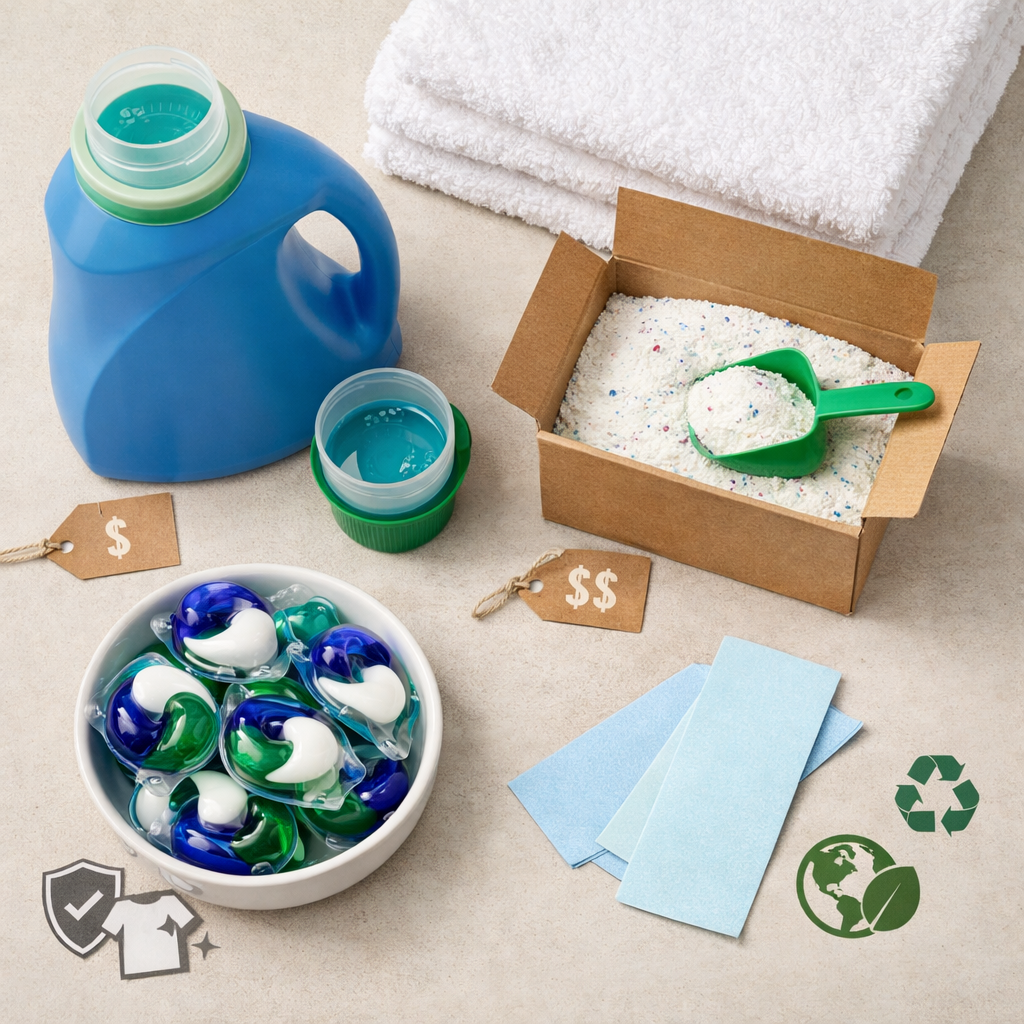
Choosing the right laundry detergent format is about fit, not a single “best.” Powders are budget workhorses that thrive in hot water; liquids are versatile and ideal for pretreating; pods deliver precision but cost more; sheets/strips are ultra‑light yet weaker; tablets are compact and improving in cold water. For most cold‑water HE machines, a concentrated liquid is the safest all‑around bet, with modern pods or tablets also performing well on standard cycles. Cleaning Supply Review distills lab-tested patterns, real cost-per-load examples, residue considerations, and packaging waste tradeoffs so you can match liquid, powder, pods/packs, sheets/strips, or tablets to your stains, water temperature, sensitivity needs, and sustainability goals.
How to choose the right format
Bottom line tradeoff:
- Powders: lowest cost per load; excellent in hot/warm water; flexible dosing but can under‑dissolve in cold.
- Liquids: versatile at any temperature; easy pretreating; more plastic packaging.
- Pods/packs: precise, consistent doses; pricier; dissolution issues on short/cold cycles.
- Sheets/strips: ultra‑light packaging; generally weaker cleaning.
- Tablets: compact, stable dosing; improving cold‑water performance (Itaconix format guide, Consumer Reports detergent buying guide).
Quick decision flow:
- Cold‑water everyday loads in an HE machine: concentrated liquid; consider pods/tablets on standard‑length cycles.
- Heavy, greasy, or hot-water washing: powder or enzyme‑rich liquid.
- Sensitive skin/low‑VOC priority: fragrance‑free, dye‑free concentrated liquid or pod labeled “free & clear,” EPA Safer Choice/UL Ecologo/NEA.
- Lowest plastic waste: powders in cardboard or tablets; credible liquid refill systems.
- Strict budget control: powder; discount/concentrated liquid with careful dosing.
Definition — Concentrated detergent (40–50 words): A concentrated detergent delivers equal cleaning with a smaller dose by increasing active ingredients and reducing water content. Because there’s less liquid to ship and store, packaging and transport weight drop. When dosed to the label, concentrated formulas clean comparably to regular versions while cutting waste and cost (Consumer Reports).
Comparison criteria and test methods
How Cleaning Supply Review assesses formats:
- Stain types: protein (blood, sweat), oil/grease, particulate (mud, clay).
- Water temperature: cold, warm, hot; cycle length and HE low‑suds needs.
- Water hardness: cleaning effectiveness and residue potential.
- Fabric/fiber residue and dye safety.
- Dissolution and dosing control.
- Cost per load and dose precision.
- Packaging waste and recyclability.
- Scent/VOCs and irritation risk.
Cleaning Supply Review synthesizes independent lab data: Consumer Reports’ ongoing tests and rankings highlight liquids and leading pods as strong overall cleaners, with powders excelling on specific stains like blood; sheets/strips underperform in labs and aren’t recommended broadly (Consumer Reports tests). Good Housekeeping’s lab work likewise finds consistent liquid standouts and documents price gaps between formats, plus viable low‑waste options that still clean well (Good Housekeeping Lab detergent roundup).
At‑a‑glance format traits
| Format | Strengths | Limitations | HE/cold‑water notes | Best uses |
|---|---|---|---|---|
| Powder | Low cost; strong on hot/protein stains; flexible dosing | Can cake or leave residue in cold; bulky for travel | Prefer warm/hot and longer cycles; check HE‑safe label | Hot‑water whites, heavy soil, budget control |
| Liquid | Works at any temp; easy pretreating; dissolves well | Plastic jugs; risk of overdosing | Top pick for cold water and HE; follow 1.5 oz benchmark | Daily mixed loads, cold cycles, stain pretreat |
| Pods/packs | Pre‑measured; consistent; multi‑chamber chemistry | Higher cost/load; less flexible; may not dissolve in short/cold cycles | Use standard‑length cycles; 1 pod for medium loads | Shared laundry, dorms, dosing control |
| Sheets/strips | Ultra‑light, minimal packaging; travel‑ready | Weaker on heavy stains; limited capacity | Works for light soils; not for tough stains | Travel, emergencies, light loads |
| Tablets | Compact; long shelf life; reduced packaging/spills | Fewer choices; may need standard cycle for full dissolve | Newer tech better in cold; verify HE‑safe | Routine loads, facilities needing dose control |
Powder
Powder detergents are budget‑friendly, shelf‑stable, and excel in warm to hot water. Flexible scoops help tailor doses to soil and load size. Their main drawback is dissolution: in cold water or short cycles, some powders can leave granules or residue on fabrics (Itaconix; Good Housekeeping). Across independent testing we review, powders often outperform on blood (a protein stain) compared with many liquids and pods, particularly in hot water (Consumer Reports tests).
Residue and exposure facts (NCBI risk assessment):
- Regular powder: a typical 150 g dose leaves about 3.8 g residue in textiles per wash.
- Concentrated powder: a 75 g dose leaves about 1.9 g residue.
- Practical tip: use warmer water or longer cycles for powders to aid dissolution (NCBI human health risk assessment on laundry detergents).
Liquid
Liquids are the versatility baseline: they dissolve readily at any temperature, perform well in cold‑water HE cycles, and can be applied directly for stain pretreating (Itaconix; Electrolux’s overview). The tradeoff is packaging: large plastic jugs add weight and waste (Get Clean People). For dosing, a practical benchmark is about 1.5 oz of liquid for an average load; many modern formulas are highly concentrated, so container sizes and cap markings may be smaller—always align dose to label guidance (Consumer Reports detergent buying guide).
Pods and packs
Pods deliver pre‑measured doses that curb overdosing and produce consistent results; multi‑chamber pods keep certain ingredients separate until the wash to boost performance (Itaconix). Drawbacks include higher cost per load, limited flexibility for pretreating, and occasional incomplete dissolution in short or very cold cycles—use standard‑length cycles for best results (Consumer Reports tests). As a price anchor, Good Housekeeping reports packs around $0.43 per load versus a typical liquid near $0.18 per load (Good Housekeeping Lab detergent roundup).
Sheets and strips
Laundry sheets/strips cut plastic dramatically and travel well. However, their limited ingredient capacity means they often lag on heavy soils and stubborn stains. Consumer Reports’ lab testing found strips performed poorly overall and does not recommend them as primary cleaners; reserve for light soils, travel, or emergencies, backed up by a separate pretreating solution (Consumer Reports tests; Itaconix; Consumer Reports buying guide).
Tablets
Tablet detergents offer solid, pre‑measured dosing with less packaging mess than loose powders and strong shelf stability (Itaconix). Newer tablet technologies have improved cold‑water dissolution while maintaining robust ingredient capacity, making tablets increasingly viable for HE machines and standard cycles (Itaconix).
Definition — Compressed detergent tablet (40–50 words): A compressed detergent tablet is a solid, pre‑measured dose formed under pressure to limit moisture exposure and reduce spills. Tablets simplify dosing, store neatly, and often use less plastic than liquid jugs. Many modern tablets are engineered for faster dissolution, including in cooler water.
Cost per load and dosing accuracy
Typical cost per load
| Format | Example/Range | Notes |
|---|---|---|
| Liquid | ≈ $0.18/load example (about 110 medium loads) | From lab pricing snapshots (Good Housekeeping Lab detergent roundup) |
| Pods/packs | ≈ $0.43/load example (63 loads/tub) | Consistency and convenience premium (Good Housekeeping Lab detergent roundup) |
| Discount liquid | ≈ $0.14/load | Value picks like Kirkland Signature Ultra Clean have tested well (Consumer Reports tests) |
Dosing control tips:
- Follow cap lines and label guidance. Aim around 1.5 oz liquid for a normal load unless otherwise directed. Don’t double up pods unless the label calls for it.
- Overdosing increases residue, cost, and rinse demand. Concentrated formats, used correctly, reduce waste (Consumer Reports buying guide).
Residue math:
- Concentrated formats leave less residual mass per wash than regular versions: powder 3.8 g vs 1.9 g; liquid 3.8 g vs 2.3 g (NCBI risk assessment).
Cleaning performance across stains and water temperatures
Patterns from independent labs: liquids and top pods frequently outclean most powders and sheets across mixed stains, while powders shine on specific protein stains like blood—especially in hot water (Consumer Reports tests). Good Housekeeping consistently observes strong liquid performers, including reliable cold‑water capability (Good Housekeeping Lab detergent roundup).
At‑a‑glance recommendations
| Stain type | Best format(s) | Best water temp | Notes |
|---|---|---|---|
| Protein (blood, sweat, dairy) | Powder (hot), enzyme liquid/pods | Warm–hot (check care labels) | Enzymes accelerate breakdown; powders excel on blood in hot. |
| Oil/grease (cooking, body oils) | Enzyme‑rich liquids/pods | Warm | Liquid surfactants solubilize oils well; pretreat with liquid. |
| Particulate (mud, clay) | Liquids/pods; powder in warm–hot | Warm–hot | Mechanical action helps; ensure full dissolution to avoid redeposit. |
Note: Biological (enzyme) detergents break down protein stains and brighten whites, but can fade delicate fabrics over time; match enzyme strength to fabric care needs (Good Housekeeping UK advice).
Hard water, septic, and machine maintenance considerations
- Hard water reduces surfactant efficiency and can increase residue. Choose formulas with chelants and enzymes, or add a water softener. For cold and hard water, prefer liquids, pods, or well‑dissolving tablets; some powders may leave undissolved particles (Good Housekeeping Lab detergent roundup).
- Septic systems: opt for low‑phosphate, lower‑surfactant‑load, fragrance‑free products and precise dosing to limit discharge volume.
- Maintenance checklist:
- Run a monthly washer clean cycle.
- Avoid chronic overdosing; measure every time.
- Use HE‑labeled detergents in HE machines to reduce sudsing and improve rinsing.
- Periodically check and clean dispensers and door seals.
Ingredients, certifications, and sensitive skin picks
Definition — Low‑VOC detergent (40–50 words): A low‑VOC detergent minimizes volatile organic compounds from fragrances and solvents to reduce indoor air emissions and potential irritation. Look for “fragrance‑free” and “dye‑free” claims and third‑party certifications such as EPA Safer Choice, UL Ecologo, and the National Eczema Association for added assurance.
Guidance for sensitive skin:
- Choose concentrated liquids or pods labeled free & clear, dose conservatively, and rinse well.
- Enzyme detergents boost cleaning but can be too aggressive for some delicates or sensitivities; test on small areas first (Good Housekeeping UK).
- For deeper ingredient guidance, see our plant‑based, hypoallergenic overview: Cleaning Supply Review’s 2026 guide to plant‑based hypoallergenic detergents for sensitive skin (internal).
Packaging waste and low‑waste refill systems
Cleaning Supply Review weighs packaging alongside cleaning performance to avoid false tradeoffs.
- Packaging impacts: liquids rely on heavy plastic jugs; powders often ship in recyclable cardboard; pods add tubs/pouches; tablets and credible liquid refill systems can sharply reduce plastic (Get Clean People; Good Housekeeping).
- Example: Good Housekeeping found Cleancult’s refillable glass bottle and paper‑based cartons to be recyclable and strong cleaners, nearly erasing all but one stain in lab tests—evidence that low‑waste can still perform (Good Housekeeping Lab detergent roundup).
Low‑waste picks by format:
- Powder: cardboard‑boxed powder (prefer concentrates to cut dose size).
- Tablets: compact, often minimal plastic.
- Liquids: reputable refill systems with recyclable cartons and durable dispensers.
- Sheets/strips: lowest weight/volume but consider as secondary for light soils given performance gaps.
Safety, storage, and correct use
Exposure context: NCBI modeling estimates about 79 mg of product dermal contact during typical handling—low, but wash hands after dosing; gloves are optional unless you’re sensitive (NCBI risk assessment).
Safe storage checklist:
- Keep products in original, labeled containers with child‑resistant closures.
- Store powders/tablets dry; reseal tightly to prevent caking.
- Lock pods away from kids and pets; never pierce pods.
- Avoid mixing chemicals; follow manufacturer guidance.
Use tips:
- Match dose to load size and soil; don’t exceed label caps or add extra pods.
- When using powders or pods in cold water, select a standard or longer cycle—or raise temperature slightly—to aid dissolution (Itaconix).
- Confirm HE‑compatibility for HE machines to control suds and improve rinsing.
Decision guide by household and facility needs
- Cold‑water, fast cycles (best laundry detergent format for cold-water HE machines): concentrated liquids first; modern pods/tablets if cycles aren’t ultra‑short.
- Heavy, hot‑water or greasy loads: powder or enzyme‑rich liquids.
- Minimize plastic waste: powders in cardboard, tablets, or credible liquid refill systems; use sheets sparingly for light soils.
- Sensitive skin: fragrance‑free, dye‑free concentrated liquid or pods; dose minimally and rinse well.
- Facility managers: standardize on dosing‑controlled formats (pods/tablets) for consistency; specify low‑VOC, fragrance‑free, HE‑safe options.
Our fit‑for‑purpose recommendations
- Best value per load: powder or discount concentrated liquid; lab data shows value liquids can rank near the top while costing ≈14¢/load (Consumer Reports).
- Best cold‑water convenience: concentrated liquid; pods/tablets also work on standard‑length cycles (Itaconix; Consumer Reports).
- Best low‑waste: cardboard‑boxed powders or tablets; credible liquid refill systems that maintain strong stain removal (Good Housekeeping).
- Best for protein stains (e.g., blood) in hot water: powder, leveraging strong performance in lab tests (Consumer Reports).
- Best for sensitive skin: free & clear concentrated liquids or pods with EPA Safer Choice/UL Ecologo/NEA indicators; dose minimally and patch‑test.
Before buying in bulk, verify label concentration and cap lines, then trial a smaller size to confirm cleaning and skin compatibility.
Frequently asked questions
Do sheets and strips clean as well as liquids or pods?
Cleaning Supply Review finds that sheets and strips reduce packaging but often underperform on heavy stains; major lab tests haven’t recommended them broadly. They’re fine for light soils and travel, while liquids and pods generally clean better day to day.
Which format works best in cold water and short cycles?
Cleaning Supply Review recommends concentrated liquids for cold water, with modern pods/tablets performing well on standard‑length cycles. Powders may struggle to dissolve in cold; use warm water or longer cycles if possible.
How can I reduce plastic waste without sacrificing cleaning power?
Cleaning Supply Review suggests powders in cardboard boxes, tablets, or credible liquid refill systems with recyclable cartons. These options cut plastic while maintaining strong cleaning when you match dose and water temperature to soil level.
What certifications should I look for for low‑VOC and skin‑sensitive detergents?
Cleaning Supply Review recommends looking for EPA Safer Choice, UL Ecologo, and National Eczema Association seals, plus “fragrance‑free” and “dye‑free” labels. These indicators signal lower VOCs and gentler formulations without giving up cleaning.
How do I dose correctly to avoid residue and higher costs?
Cleaning Supply Review advises following the label’s load‑size lines—target about 1.5 oz of liquid for an average load—and never double pods unless directed. Correct dosing minimizes residue, protects fabrics, and lowers cost per wash.