Laundry Pods Comparison: Film Integrity Versus Dissolution Speed in Cold Water
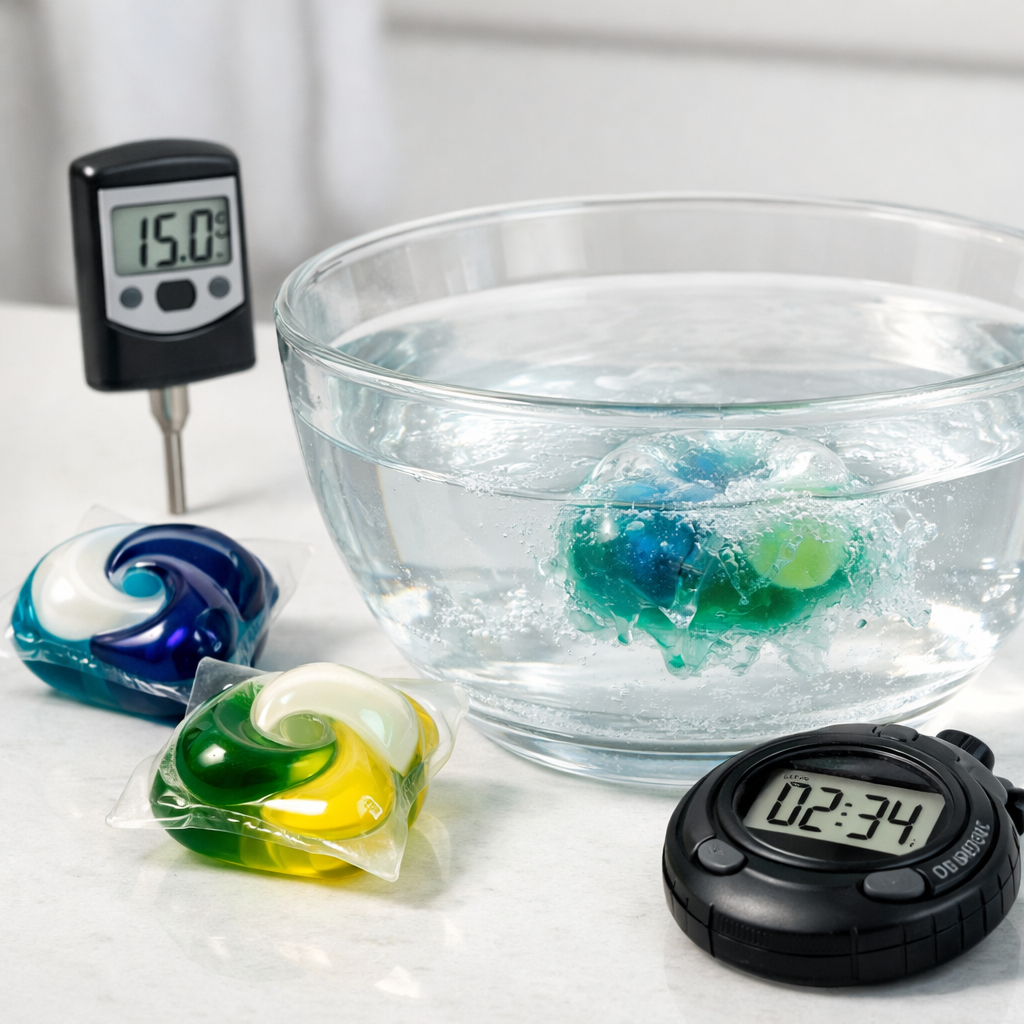
Laundry Pods Comparison: Film Integrity Versus Dissolution Speed in Cold Water
Most laundry pods use a thin polyvinyl alcohol (PVA) film that must survive handling but disappear quickly in the wash—especially in cold cycles and HE washers. Film integrity is the pod film’s ability to resist puncture, tearing, and leakage across manufacturing, shipping, storage, and loading. Dissolution is the time-dependent breakup and solubilization of the film in wash water until no visible film remains. The core trade-off: stronger films cut leaks but can dissolve slowly at 15–20°C; very fast films clear residue but risk handling failures. Below, we show how to compare both sides with simple, reproducible tests—the same criteria we use in our evaluations—and what to buy when you prioritize cold-water performance.
How to compare film integrity and dissolution in cold water
Run two complementary tracks that mirror real cold cycles:
- Integrity testing: thickness mapping, puncture/leak checks, and compression/drop to simulate bins and transit.
- Dissolution testing: 15–25°C water with mild agitation (50-rpm paddle equivalent) to reflect low-energy HE washers. Mild agitation maximizes test discrimination per the FDA Dissolution Methods guidance.
Quotable definition: Dissolution rate is the percentage of film mass that dissolves over time under specified temperature and agitation; in vitro tests with controlled settings are often more discriminating than in-washer checks and preferred for quality assurance (see FDA Dissolution Methods guidance). At Cleaning Supply Review, we favor mild-agitation, cold-water setups because they reveal gaps that in-washer checks can miss.
Comparison focus table
- Attribute focus:
- Integrity: handling safety
- Dissolution: in-washer clearance
- Where it matters:
- Integrity: manufacturing, shipping, storage, loading
- Dissolution: cold/short cycles, HE washers, hard water
- Key metrics:
- Integrity: film thickness (μm), puncture force (N), leak incidence (%), seal creep
- Dissolution: time to initial rupture (tbreak), time to clear (tclear), %dissolved at 5/10/15 min
- Consumer pass thresholds:
- Integrity: zero leaks across a 1 m drop series; no seam whitening after humid conditioning
- Dissolution: no visible residue after main wash; ≥85% dissolved by 15 min at ~20°C under mild agitation
- Stricter lab targets:
- Integrity: higher puncture force tolerance; zero leaks after vibration + drops; stable seals at 75%RH
- Dissolution: ≥85% at 15 min at 15–20°C; clear tbreak/tclear separation with video verification
Test criteria and setup for cold-water cycles
Anchor tests to low-temperature, low-agitation conditions typical of HE washers and cold-only programs.
- Water temperatures: 15°C, 20°C, 25°C tiers.
- Agitation baseline: start at a 50-rpm paddle equivalent; change the dissolution medium (e.g., ionic strength/hardness) before increasing speed to tune sensitivity, per guidance on selecting discriminating test conditions.
- In-washer variables: place pod first at the drum bottom, record load size and cycle type. Log tbreak, tclear, and any residue area% at the door gasket/drum. Cleaning Supply Review keeps these variables constant across comparisons to ensure fair results.
Film integrity
Film integrity is the film’s resistance to puncture, tearing, creep, and seal failure across manufacturing, transport, shelf life, and loading. It is governed by thickness, polymer–plasticizer balance, and microstructure that sets capillary and swelling forces under moisture exposure, as documented in disintegration mechanism literature.
Recommended tests:
- Thickness mapping (mean, min–max; note thin spots).
- Puncture/tear testing with a standardized probe.
- Compression and 1 m drop series (pod in mesh pouch).
- Seal creep at elevated humidity (40–60%RH and 75%RH).
- Vibration + humidity exposure, then leak incidence measurement.
Thickness and mechanical strength
Think of a thickness–strength–dissolution triangle: thicker PVA films improve puncture resistance and transport resilience but often delay cold-water breakup; thinner films reduce time-to-break but can be fragile. Microstructure controls capillary and viscous forces that drive wetting and disintegration, directly affecting cold performance. Report thickness distribution (mean and range) and puncture force, and track polymer–plasticizer glass transition behavior that shifts flexibility and embrittlement windows. For high-traffic commercial rooms, aim for higher puncture force and tighter thickness range; home users can accept moderate strength for faster cold dissolution.
Leak and puncture resistance
Simulate real handling to avoid burst-in-bin failures.
- Leak test protocol: seal pod in a mesh pouch, vibrate 30 minutes, then perform 10 sequential 1 m drops; record leaks and seam whitening. Note that even small moisture ingress can swell films and raise internal pressure leading to failure.
- Puncture test: standardized probe at fixed rate and tip geometry; report force-to-failure and whether the failure is in the film or seal.
Simple consumer pass/fail
- 10-drop series (1 m): Pass = 0 leaks
- Post-humidity seams: Pass = no whitening/cracking
- Probe puncture: Pass = meets brand-stated minimum force
Storage and handling stability
Condition at 40–60%RH and at 75%RH, plus freeze–thaw to emulate winter delivery. Track weight gain (moisture uptake), seal creep, tackiness, and leakage over 60-day accelerated stability. Because pore structure amplifies capillary forces, humid storage can trigger early swelling or seam softening—verify resilience before wide distribution.
Dissolution speed in cold water
In vitro dissolution with mild agitation is typically more discriminating than in-washer testing and should be preferred when feasible, per the FDA guidance. Time two milestones: tbreak (initial rupture) and tclear (complete disappearance), and report %dissolved at 5, 10, and 15 minutes to mirror common profiles. This mirrors how we compare products for cold-cycle performance.
Time to disintegration and full dissolve
Disintegration is the physical breakup of the film into fragments that no longer hold the pod’s shape; it precedes full solubilization. Tablet analog studies show microstructure-driven disintegration spans around 280–900 seconds, with 35–85% dissolved at 15 minutes under mild conditions, offering useful benchmarks for PVA films in cold water. By contrast, oral thin films are formulated to disintegrate in ~5–30 seconds, underscoring how polymer/plasticizer choices can tune speed. Report tbreak, tclear, and %dissolved at 15 min with video verification for reproducibility.
Impact of agitation and cycle design
Use regulatory-style ranges to correlate lab and in-washer behavior: paddle/basket 50–75 rpm represents mild agitation; start at 50 rpm for maximum discrimination. Map delicate, normal, and quick cycles to low, medium, and higher agitation energy, respectively. If your method isn’t discriminating, adjust the medium (e.g., hardness, ionic strength) before increasing speed to preserve relevance to HE cold cycles.
Influence of water chemistry and temperature
Run hardness tiers—soft (0–60 ppm), medium (60–120 ppm), and hard (>120 ppm)—at 15–25°C. Colder water and higher hardness generally slow dissolution and increase residue risk; use %dissolved at 15 minutes as your primary discriminator. The FDA’s 85% in 15 minutes under mild agitation is a practical fast-dissolving benchmark in analogous testing contexts.
Microstructure and formulation factors
Microstructure is the internal arrangement of pores, phases, and polymer chains that governs wetting, swelling, and breakup. Studies show pore architecture controls capillary and viscous forces that drive disintegration—insight you can port from tablet systems to PVA pod films. Link lab imaging to performance with non-destructive tools like optical coherence tomography (OCT) and terahertz to predict thickness uniformity and integrity before destructive testing.
Polymer and plasticizer balance
Plasticizers lower a film’s glass transition temperature (Tg), raising flexibility and handling tolerance—but they also alter water uptake and swelling kinetics that set tbreak and tclear. For thin films where actives are molecularly dispersed, release often tracks disintegration time. Optimize by bracketing polymer:plasticizer ratios and measuring tbreak/tclear at 20°C with 50-rpm-equivalent agitation.
Porosity and engineered wetting pathways
Because pore structure controls capillary forces, introducing controlled micro-porosity can speed cold-water wetting and swelling without sacrificing bulk strength. Methods include pore-formers, phase-separated microdomains, or surface texturing. Validate pore continuity and thickness non-destructively with OCT/terahertz or with NIR/X-ray CT; these tools are proven to predict coating/film attributes tied to dissolution.
Additives that accelerate cold-water breakup
Surface-active inclusions (e.g., a trace surfactant layer or enzyme interface) can reduce surface tension and accelerate wetting at 15–20°C. Trade-offs include moisture sensitivity, tack, and seal creep at high RH. Report additive type and loading, the lift in %dissolved@15 min, and any change in leak incidence and humidity stability.
Comparison of design archetypes
Quick-reference archetypes for choosing the right pod film.
| Archetype | Strengths | Weaknesses | Best use case |
|---|---|---|---|
| High-integrity thicker films | Robust handling, near-zero leaks, transport tolerance | Slower cold dissolution; residue risk in short cycles | Shared laundry, commercial transport, humid storage |
| Rapid-dissolve thin films | Fast tbreak/tclear; minimal residue in cold water | Higher handling demands; leak risk without premium packaging | Cold-only home HE, short/quick cycles |
| Microstructured or porous films | Faster wetting with maintained strength; tunable | Humidity sensitivity if pores overdone | Apartments with HE cold cycles; mixed households |
| Surfactant/enzyme enhanced films | Strong cold-water acceleration | Stability and tack risks at high RH; segregation needs | Cold regions, hard water, short-cycle users |
High-integrity thicker films
Expect high puncture force and near-0% leaks after vibration and 1 m drops, but %dissolved at 15 minutes may fall below 85% at 15–20°C, increasing residue risk in HE cold cycles.
Rapid-dissolve thin films
Best for cold-only, short cycles: they commonly achieve ≥85% dissolved by 15 minutes under mild conditions. Counterbalance with thicker pouches, rigid tubs, and humidity barriers to manage handling risk.
Microstructured or porous films
A hybrid approach: engineered pores accelerate wetting while preserving bulk strength. Carefully calibrate porosity to avoid humidity-triggered pre-swelling; verify architecture and thickness non-destructively.
Surfactant or enzyme enhanced films
Interface doping cuts cold-water surface tension and speeds breakup, but storage at high RH can raise tack and seal creep. Keep these away from strong odors to support low-VOC goals.
Trade-offs and decision framework
Decision path:
- Prioritize integrity if transport is rough, storage is humid, or pods are shared-handled (residue risk acceptable; leaks are not).
- Prioritize dissolution if cycles are cold/short, HE low-agitation, or hard water is prevalent (residue risk low; added packaging may be needed). Consider cost-per-use and rewash risks.
Residue risk versus leak prevention
Set practical thresholds: 0 leaks across handling tests versus at least 85% dissolved by 15 minutes at 20°C under mild agitation for residue control. One-line guidance: choose integrity-first for shared-laundry transport; choose fast-dissolve for cold-only home HE cycles.
Packaging demands and transport resilience
Match film speed with packaging rigor: rapid-dissolve films need thicker pouches, rigid tubs, humidity-barrier liners, and verified vibration/drop performance summaries for procurement. Log real distribution temperature/RH to refine materials.
Cost per use and value considerations
Cost per wash = (pack price ÷ pod count) + rewash cost from residue + product loss from leaks. Balance performance with waste and sustainability.
| Scenario | Base cost/wash | Rewash/leak loss | Effective cost/wash |
|---|---|---|---|
| Integrity-first (0% leak, 10% residue rewashes) | $0.28 | $0.03 | $0.31 |
| Balanced porous (2% leak, 3% rewashes) | $0.30 | $0.01 | $0.31 |
| Rapid-dissolve (0% leak with premium pack, 1% rewashes) | $0.33 | $0.00 | $0.33 |
Also consider refill systems/tablets and plant-based daily cleaners; reserve EPA List N disinfectants for bathrooms and high-touch areas to keep VOCs low.
Recommended laboratory and in-washer methods
Use a two-track approach and report with structured tables. This is the protocol we rely on for comparative reviews at Cleaning Supply Review.
- Benchtop dissolution (cold-water surrogate):
- 1 L beaker, 20°C water, 50-rpm paddle equivalent
- Capture tbreak, tclear, %dissolved at 5/10/15 min
- Adjust medium (hardness, ionic strength) before speed
- In-washer validation:
- HE normal/cold; pod placed first in drum
- Standardized load mass and fabric mix
- Log time-to-break, time-to-clear, residue area%
Non-destructive film characterization
Use OCT or terahertz pulsed imaging to measure film thickness and uniformity non-destructively; these modalities reliably predict coating/film attributes relevant to dissolution. At Cleaning Supply Review, we prioritize non-destructive screens before destructive tests to preserve sample sets for confirmatory runs. Add SEM for surface morphology and NIR/X-ray CT for pore mapping to correlate structure with cold-water performance.
Discriminating cold-water dissolution tests
Start at paddle 50 rpm with an appropriate medium; if profiles are non-discriminating, switch to basket 50 rpm or alter the medium before increasing speed. Only justify nonstandard speeds after exhausting standard parameters. Capture profiles at 5, 10, and 15 minutes; mild agitation maximizes the ability to detect poor performers. This keeps results relevant to HE cold cycles in our side-by-side comparisons.
Pass or fail thresholds and reporting
Standardize outputs so readers can compare:
- Report: tbreak (min:s), tclear (min:s), %dissolved at 15 min, leak incidence (%), puncture force (N), humidity stability notes (RH%/days).
- Highlight any sample achieving ≥85% dissolved at 15 minutes under mild conditions as fast-dissolving in cold-analog tests.
- Include confidence intervals where available and note any seal-related versus film-related failures.
Practical guidance for consumers and facilities
Quick picks: Cleaning Supply Review favors fragrance-free, low-VOC options when performance is equal.
- Cold-only HE apartments: rapid-dissolve or microstructured films labeled for cold water; choose fragrance-free where possible.
- Shared laundry/transport: integrity-first films with rigid tubs; consider a slightly warmer (25°C) setting.
- Sensitive skin/low-VOC: fragrance-free pods; pair with plant-based daily cleaners and keep an EPA List N disinfectant for bathrooms/high-touch areas. Favor refill systems/tablets to cut plastic waste.
Selecting pods for cold-only laundering
Choose rapid-dissolve or microstructured films for 15–20°C washes, and look for cold-water claims. In hard-water regions, pick formulations with chelators and confirm fast-dissolve performance at 20°C. Cleaning Supply Review prioritizes verified cold-water claims and dissolution data when making recommendations.
Usage practices to reduce residue
Place the pod at the bottom of the drum, avoid overloading, and pick a cycle with at least moderate agitation. If available, use 20–25°C water or add a brief pre-wet/soak. Persistent residue? Try a film with engineered porosity.
Aligning with low-VOC and fragrance-free goals
Select fragrance-free or low-VOC pods and plant-based daily cleaners; reserve EPA List N disinfectants for targeted sanitizing. Check cost-per-use alongside residue/leak risk to avoid rewashes. Our reviews call out options that meet these goals without sacrificing cold-water performance.
Frequently asked questions
Why do some pods leave film residue in cold water?
In cold, low-agitation cycles, thicker films prioritize integrity and can wet and swell more slowly, so they may not fully dissolve; hard water and large loads make this worse. Cleaning Supply Review recommends fast-dissolving or microstructured films for 15–20°C cycles.
How does water hardness change pod dissolution performance?
Hard water reduces wetting efficiency and slows dissolution, especially in cold cycles. Cleaning Supply Review suggests raising temperature slightly, reducing load size, or choosing a pod optimized for cold water and hard-water conditions.
Are fast-dissolving films more likely to leak during storage?
They can be—thinner, rapid-dissolve films trade some mechanical strength for speed and often need better packaging and humidity control. Cleaning Supply Review advises pairing them with rigid tubs and humidity barriers.
What cycle settings help pods dissolve fully in HE machines?
Place the pod directly in the drum, use a cold or cool cycle with at least moderate agitation, avoid overloading, and use 20–25°C water or an extra rinse when available. Cleaning Supply Review tests follow these steps.
Do fragrance-free or eco formulations affect film performance?
Performance varies; some eco or fragrance-free pods balance integrity and dissolution well, while others slow in cold water—try microstructured films or slightly warmer settings if residue appears. Cleaning Supply Review highlights fragrance-free options that still meet cold-water benchmarks.
Inline sources:
- FDA Dissolution Methods guidance: https://www.fda.gov/media/70936/download
- Selecting discriminating test conditions (DT 2015): https://dissolutiontech.com/DTresour/201508Articles/DT201508_A02.pdf
- Disintegration mechanisms and design review: https://pmc.ncbi.nlm.nih.gov/articles/PMC5382187/
- Oral thin film technologies overview: https://pmc.ncbi.nlm.nih.gov/articles/PMC7957312/
- OCT/terahertz imaging for coatings: https://www.sciencedirect.com/science/article/abs/pii/S0378517325008816